


Car frame damage is any bend, twist, or crush in a vehicle’s structural skeleton, whether that skeleton is a unibody shell or a separate ladder frame, serious enough to move it out of factory specification. Most of it can be repaired on a straightening bench. The exceptions are kinked high-strength steel, corrosion in the area a pull needs to grip, and damage that costs more to fix than the car is worth.
Frame damage means the unibody shell or ladder frame has shifted out of factory alignment. Watch for uneven panel gaps, a crooked steering wheel on a straight road, and tires wearing unevenly. Most of it straightens back to spec on a measuring bench. A kink in high-strength steel, hidden corrosion, or a repair cost past the car’s value are the exceptions.
Unibody vs. full frame: what “frame” means on your car
“Frame” means two different things depending on what’s parked in the driveway, and the difference decides how damage gets fixed.
Most cars, crossovers, and modern SUVs are built around a unibody frame: the floor pan, rails, and pillars are welded into a single structure that also serves as the body. There’s no separate frame bolted underneath. Nearly every passenger car has been built this way since the 1990s, because a unitized body is lighter and manages crash energy better than a separate frame. Engineers design specific sections, called crumple zones, to fold and absorb crash energy so the passenger cabin stays intact. When a unibody takes a hit, the load doesn’t stay local: an impact at one rear corner can change the readings at the opposite front strut tower.
Trucks and body-on-frame SUVs work differently. They carry a separate ladder frame under the body, two long steel rails joined by crossmembers, with the cab and bed bolted on top through rubber body mounts. Damage to that frame behaves more like bending a length of structural steel: a rail twists over its length, a crossmember shifts, and the rubber mounts holding the body down shear loose.
Either way, a shop working structural damage measures the result against the manufacturer’s factory specifications, checking the structure point by point against the exact data for that model year. That number, not how the car looks from the outside, decides whether the structure is still doing its job.
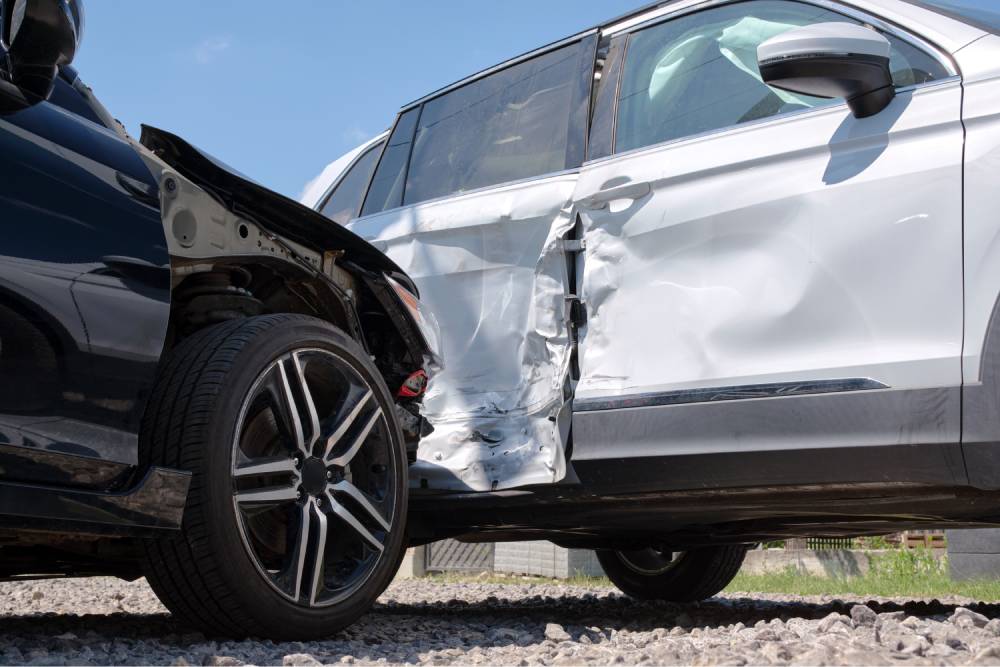
7 signs your car has frame damage
None of these signs prove frame damage by themselves, but together they’re the pattern a technician looks for before a car ever goes on a bench.
- Uneven panel gaps. When the structure underneath shifts, the sheet metal bolted to it no longer lines up the way it did at the factory, so the gap between the hood and fender, or between two doors, widens on one side and narrows on the other.
- A steering wheel that sits off-center on a straight road. If a frame rail or strut tower has moved even a few millimeters, the front wheels no longer point where the steering wheel says they should, so the wheel sits crooked just to keep the car tracking straight.
- Doors, a trunk, or a hood that bind or won’t close cleanly. Body openings are cut to tight factory tolerances, and a structure that’s out of alignment pulls those openings out of square, so a door that used to close with a light push now needs a shove.
- Tires wearing unevenly on one edge. A shifted frame changes suspension geometry, which changes camber and toe, and tires scrub against the road at an angle instead of rolling flat.
- The car pulls to one side or drives slightly sideways, sometimes called crab-walking. This happens when the rear axle no longer sits parallel to the front, so the whole car travels at a slight angle even while pointed straight ahead.
- Ripples, wrinkles, or a visible kink near the rails or pillars. Steel bent past its limit doesn’t spring back smooth, and a crease is a sign the structure absorbed more force than it could flex through.
- Wind noise, a water leak, or glass that cracks without being struck. Seals and glass sit in openings that assume the body is square, and a distorted structure opens gaps a seal was never designed to bridge.
The main types of frame damage
Shops that measure structural damage for a living group most of it into four broad types, based on the direction the frame moved rather than how bad the collision looked.
| Type | What happened | Typical source of impact |
| Sway | The frame shifted sideways off the vehicle’s centerline | A sideswipe or an angled hit to one corner |
| Twist | One corner of the frame sits higher or lower than the opposite corner | Hitting a curb, pothole, or median with one wheel at speed |
| Mash (crumple) | A section compressed and shortened the way a crumple zone is designed to | A direct frontal or rear collision |
| Sag | The frame bent downward through the middle | A heavy front or rear impact on rails already weakened by corrosion |
Some classifications add a fifth type, diamond, where one rail gets pushed rearward relative to the other and the frame sits out of square. It’s mostly a ladder-frame pattern and rarely shows up alone.
A single accident can produce more than one type at once. A hard hit on a pothole along Biscayne Boulevard can twist a rail and shift it sideways in the same event, which is why a technician measures the whole structure rather than guessing from where the dent is visible. The type of damage also hints at repairability before the car reaches a bench: sway and twist are usually correctable with controlled pulls, while a mash crushed through a crumple zone often calls for section replacement instead of straightening.
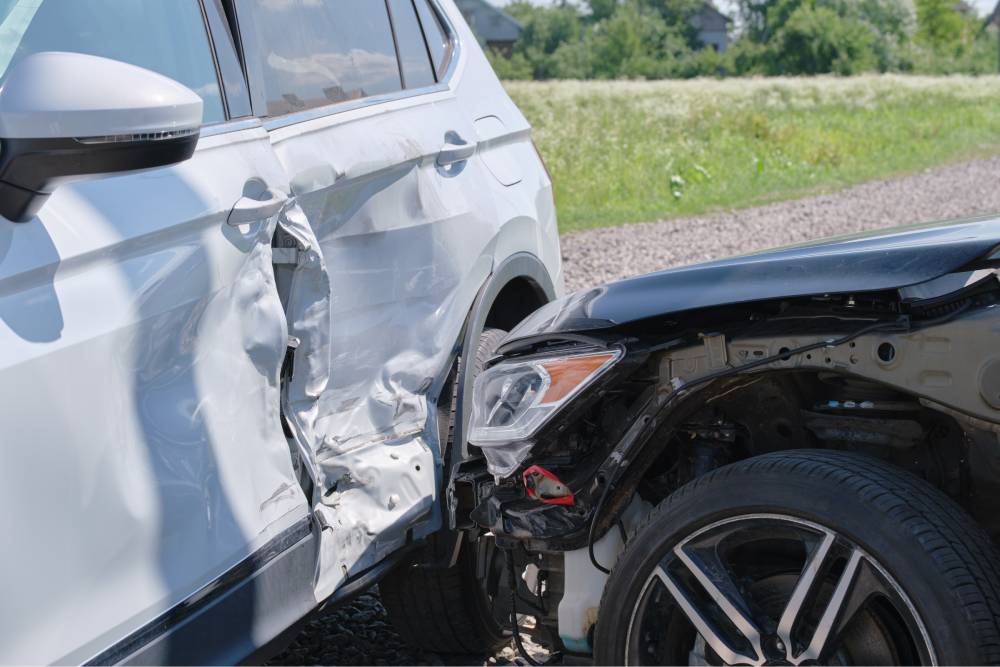
Can frame damage always be repaired?
No, and the honest answer sits between two extremes. Frame damage isn’t automatically a death sentence for a car, but it isn’t automatically fixable either. What decides it is measurement, not how bad the collision looked in photos.
What a straightening bench can fix
Most sway, twist, and moderate mash damage pulls back to factory specification. The vehicle is mounted on a chassis bench and anchored at fixed points, then pulling towers apply controlled force opposite the original impact while a computerized system tracks each control point against the manufacturer’s data. When every point falls back inside tolerance, the repair is verified, not guessed at. Sections that do need replacing use parts built to the same specification as the originals, and our guide to OEM and aftermarket parts explains why that distinction matters.
When the frame can’t be saved: kinks, corrosion, stacked damage
Three things take a repair off the table. The first is a kink, a sharp crease rather than a gradual bend. Kinked high-strength or boron steel can’t be pulled straight, and heat isn’t an option either: those alloys lose their engineered strength when heated, a point collision-repair guidance on cold straightening is blunt about. A kinked section gets replaced at a factory seam instead. The second is corrosion in the metal that has to carry the pull, a real concern on cars that have spent years in Florida’s coastal humidity and salt air; rusted structural metal has to be cut out and replaced before anything can be pulled against it. The third is stacked damage, more than one collision overlapping the same section, which leaves nothing clean to measure against.
When the math totals the car, not the damage
The other limit isn’t about steel at all. When the cost of a verified repair gets close to what the car is worth, an insurer declares a total loss regardless of whether the frame itself could be pulled back to spec. That’s an arithmetic decision, not an engineering one, and it’s part of why the insurance side of a structural repair matters as much as the bench work. A well-worn daily driver hits that threshold on far less damage than a newer or luxury vehicle carrying the same measurement report.
How frame straightening actually works
The repair itself is more measurement than muscle. A car with suspected structural damage goes on a chassis bench first, anchored at the pinch welds so it can’t move during the pull. A computerized system checks more than a hundred control points against the factory data for that exact model and year, and the report shows which points moved and how far before anything gets pulled. I-CAR certified technicians run that process, and every reading is logged before, during, and after the pull.
Pulling towers then apply force gradually, in the order opposite to how the damage happened, while the measuring system reports movement in real time. High-strength and boron steel sections don’t get heated to speed the process up. Once the structure measures back inside tolerance, the job isn’t finished: suspension geometry gets checked and reset, and any vehicle with driver-assistance cameras or radar needs those sensors recalibrated, because they aim relative to the car’s centerline. For the full process, including how unibody and full-frame repairs differ, see our professional frame straightening page.
What “frame damage reported” means on a vehicle history report
“Frame damage reported” is a flag that shows up on services like Carfax once an insurance claim, a repair shop, or an inspection has documented structural damage on that specific vehicle. It doesn’t say whether the repair was done well, or done at all. It just says the event happened. And it doesn’t expire: the note follows the VIN from owner to owner.
That flag tends to stick around longer than the memory of the accident. A buyer running a history report sees “structural damage” and, fairly or not, treats it as a warning sign regardless of how thorough the repair actually was. Dealers use the same report to set a trade-in offer, and the discount rarely distinguishes a properly measured, warrantied repair from one patched together to pass a visual check.
Documentation is what closes that gap. A before-and-after measurement report, showing every control point checked against factory data, is the difference between “trust us” and proof the structure is sound. On a newer or higher-value vehicle, the value lost to a frame damage flag can be significant enough that a diminished value claim against the at-fault driver’s insurer is worth pursuing, separate from the cost of the repair itself.
Is a car with frame damage safe to drive?
Usually not, and the risk isn’t always obvious from the driver’s seat. A frame or unibody that’s out of alignment changes how the car tracks in a straight line and how the suspension takes the next bump, and it wears tires fast on one edge. None of that shows up as a warning light.
The bigger concern is the next impact, not this one. Crumple zones and load paths are engineered to move crash energy along a specific route around the cabin. Once that structure has shifted, the next collision, even a minor one, doesn’t necessarily follow that route. Airbag timing and the rest of the safety system assume a structure still sitting in spec. Until a measurement confirms otherwise, treat a car with suspected frame damage as compromised and limit driving to what’s necessary to get it checked.
What frame repair costs
Frame repair cost, sometimes asked about as chassis repair cost, swings wider than almost any other collision repair, because the range covers everything from a short single-session pull to a multi-week structural rebuild. A minor sway or twist corrected on a bench, without any section replacement, typically runs in the $600 to $1,500 range. Serious structural damage that requires cutting out and replacing sections, plus the alignment and ADAS recalibration that follow, can run from roughly $2,000 to $10,000 or more. Treat both as a typical range, not a quote for any specific vehicle. Somewhere above those figures, the deciding question stops being what the repair costs and starts being whether it’s still less than the car is worth.
FAQ
Not by itself. A car is totaled when the repair cost approaches its market value, which is an insurance calculation, not a verdict on the frame. Plenty of frame damage is measured, pulled back to factory specification, and verified. An older sedan reaches that math threshold much sooner than a newer luxury car does.
Usually no, and you often cannot tell from the driver’s seat. A shifted structure changes how the car tracks, wears tires unevenly, and can alter how crumple zones absorb the next impact. Until the frame has been measured on a bench, treat the car as compromised and limit driving to what is necessary.
The visible pattern is panel gaps that changed after the impact, a door or trunk that suddenly needs force to close, a steering wheel that no longer sits centered, and new uneven wear on the tires. Any one of these justifies a measurement on a bench, the only check that confirms or rules out frame damage.
More than the repair itself suggests, because “frame damage reported” stays on the vehicle history report even after a verified repair. Dealers and buyers routinely discount such cars, and on newer or luxury vehicles that gap can be worth pursuing as a diminished value claim against the at-fault driver’s insurer.
Get your car measured before you decide anything
Frame damage is one of the few things at a body shop that shouldn’t be guessed at from the driveway. A hard pothole hit, a curb clipped pulling into a parking garage, or a collision report with “structural damage” noted anywhere on it are all reasons to get the structure measured before assuming the worst, or assuming it’s fine.