The storm passed in twenty minutes. Your car was parked outside. Now you’re walking around it in the driveway, and at first glance everything looks fine — a few small marks on the hood, maybe. Then you move into the sunlight and count thirty dents across the roof alone.
Hail damage is deceptive. It rarely looks as serious as it is, and the visible dents are only part of the story.
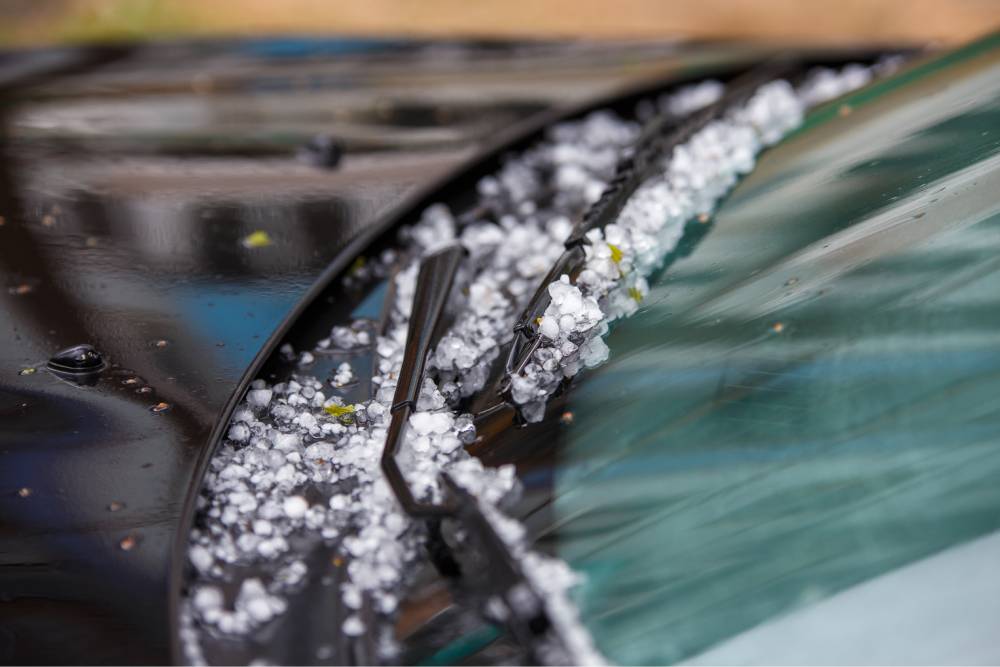
Hail damage shows up as shallow dents on horizontal panels — hood, roof, trunk — plus potential paint chipping, cracked glass, and damaged trim or rubber seals. Small dents with intact paint are usually good PDR candidates. Deeper dents or cracked paint require conventional repair. Comprehensive insurance covers hail damage; whether filing makes sense depends on your deductible versus the repair estimate. Get the car inspected quickly — some damage worsens if seals or glass are compromised and water gets in.
What hail damage actually looks like
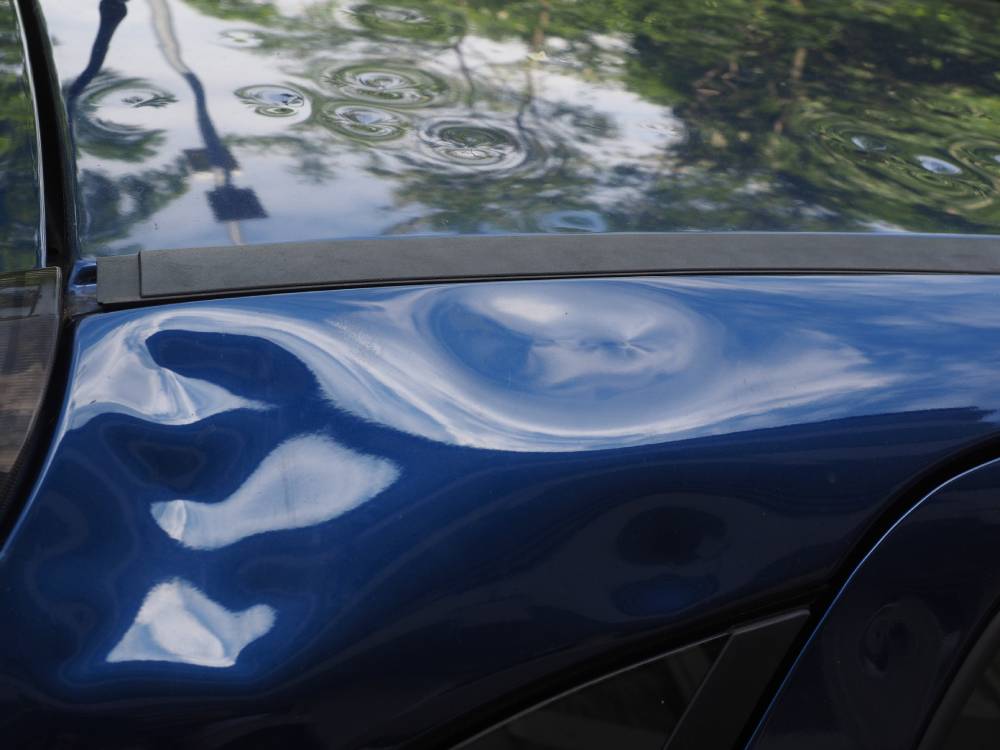
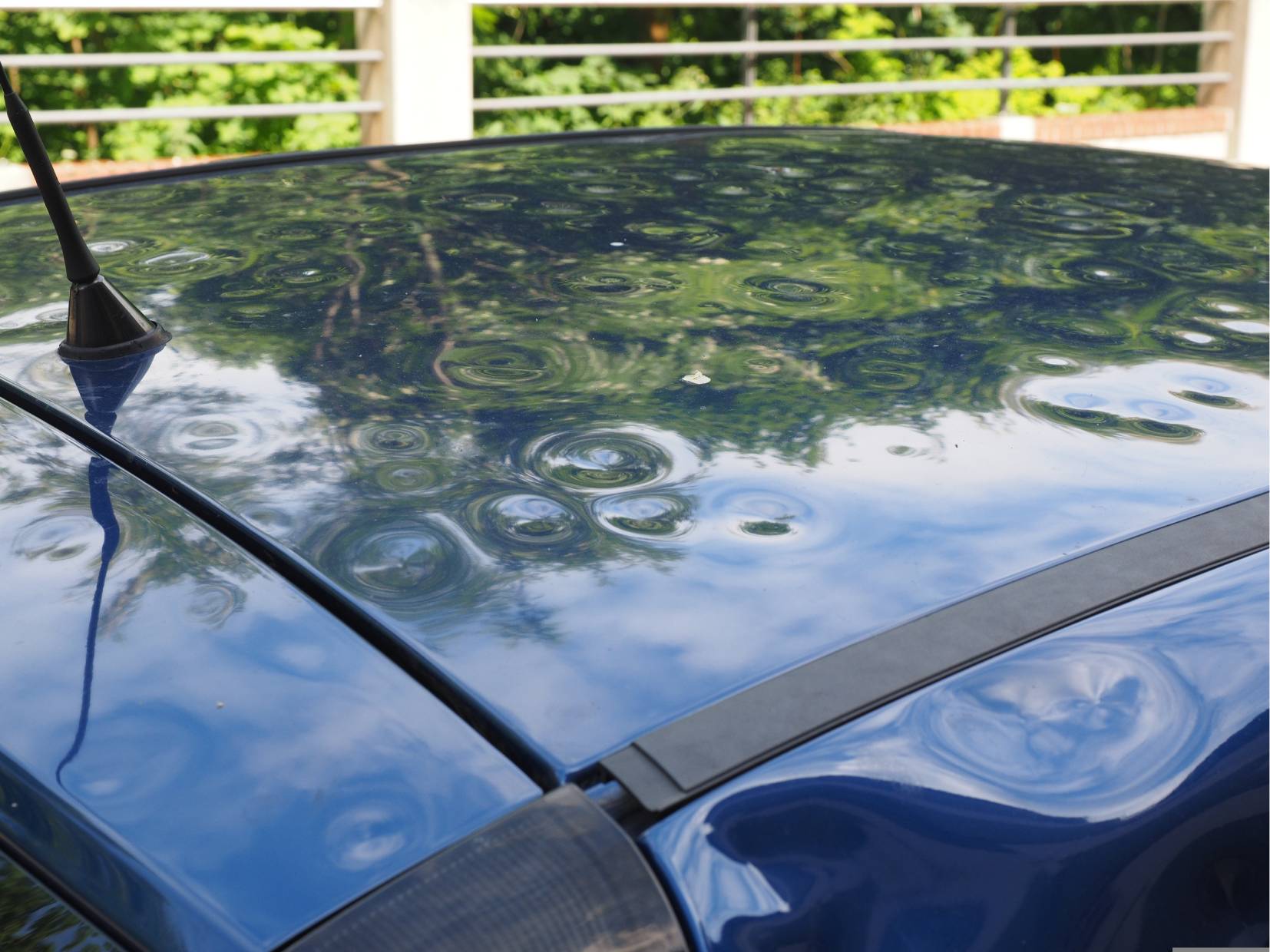
The most obvious signs are the dents themselves — shallow dimples spread across horizontal surfaces. Hood, roof, and trunk lid take the most hits because they face directly upward. Doors and fenders catch less damage unless the storm came with wind-driven hail at an angle.
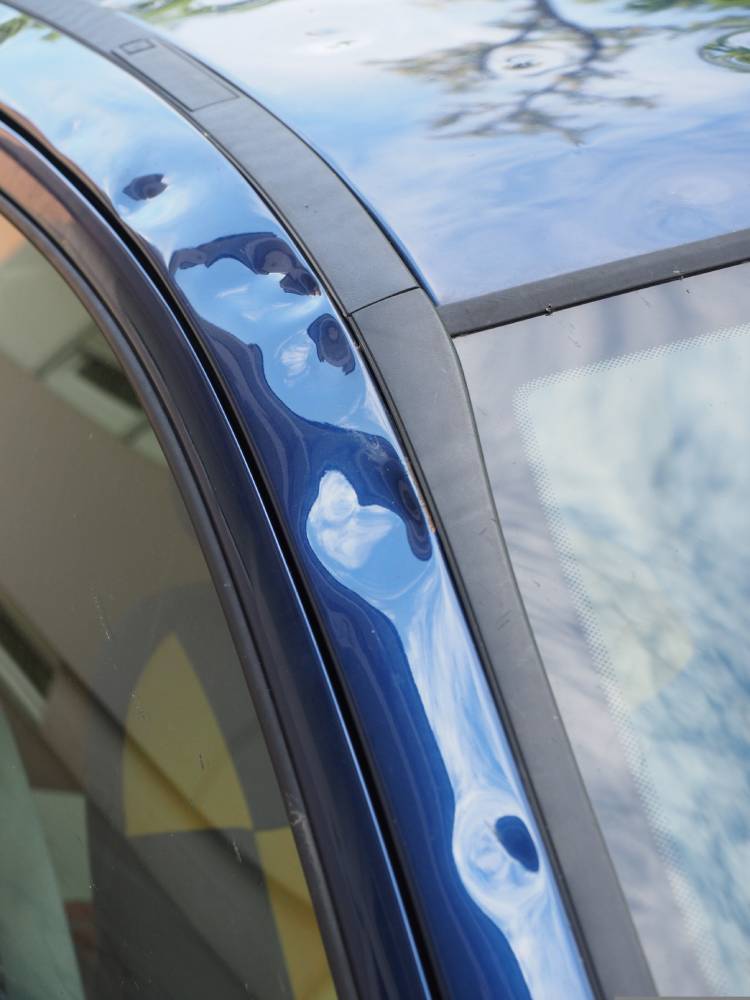
The dents are easiest to see in bright sunlight or under strong overhead lighting. The surface doesn’t always look dented straight-on; it looks distorted. Move around the car and look at panels at a low angle with light reflecting off the surface — that’s when shallow dents become visible as breaks in the reflection.
Beyond the metal panels, hail can affect:
Paint. Direct impact from large hailstones can chip or crack the clear coat and color layer. Smaller stones may leave micro-cracks that aren’t visible immediately but allow moisture to work under the paint over time, leading to bubbling or rust months later.
Glass. Windshields, rear glass, and sunroof panels can crack from hail impact. Sometimes the crack is obvious; sometimes it’s a small chip at the edge that expands with temperature changes over the following weeks.
Trim and moldings. Plastic trim pieces, mirror housings, and moldings crack or scuff more easily than metal panels. Damage here is often overlooked during a quick visual inspection.
Rubber seals. Door seals, window seals, and sunroof gaskets can be loosened or cracked by repeated impacts. Compromised seals lead to water intrusion — not immediately visible, but potentially causing interior moisture damage and mold over time.
The damage you might not see right away
Some of the real cost of hail damage shows up later, not during the initial inspection. This is why a professional assessment matters even when the car looks like it only has a few small dents.
Paint micro-cracks may not be visible to the naked eye but become apparent under UV light or when a technician inspects the surface closely. If left untreated, they allow moisture under the clear coat. In South Florida’s humidity, that process accelerates.
Glass damage that looks like a minor chip can spread. Temperature cycling — hot days, air-conditioned interiors — creates stress at the chip point. A small edge chip in the windshield after a storm can become a full crack within weeks.
Water intrusion through damaged seals is the slowest and most expensive hidden consequence. By the time it becomes visible — damp carpet, fogged windows, musty smell — the moisture has often been present long enough to affect more than just the seals.
PDR or conventional repair: how the damage type determines the method
Not all hail damage is repaired the same way. The repair method depends on the size and depth of the dents, whether the paint is intact, and what panels are affected.
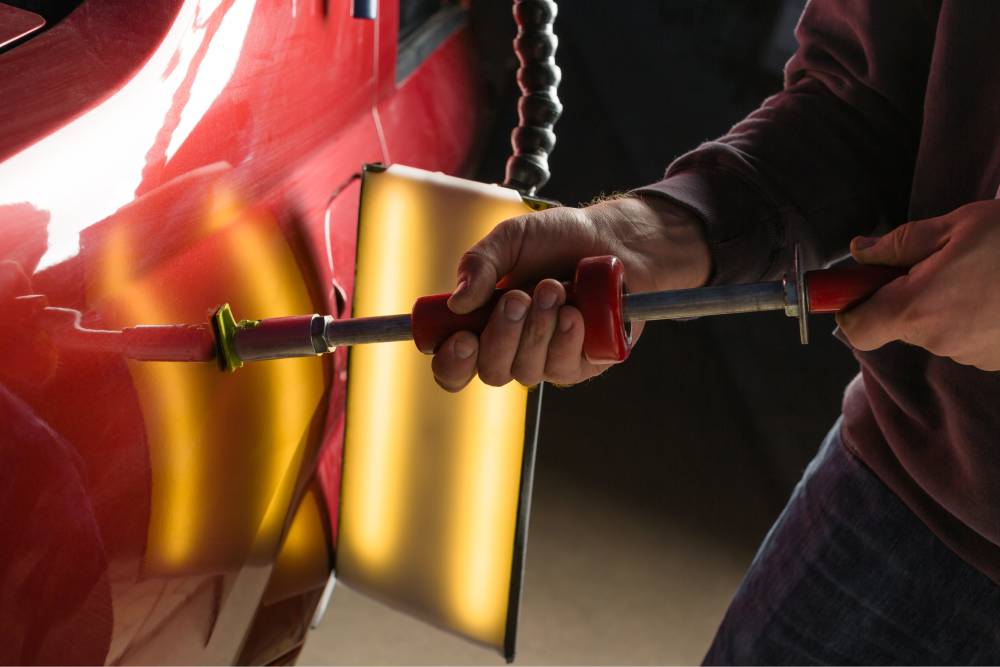
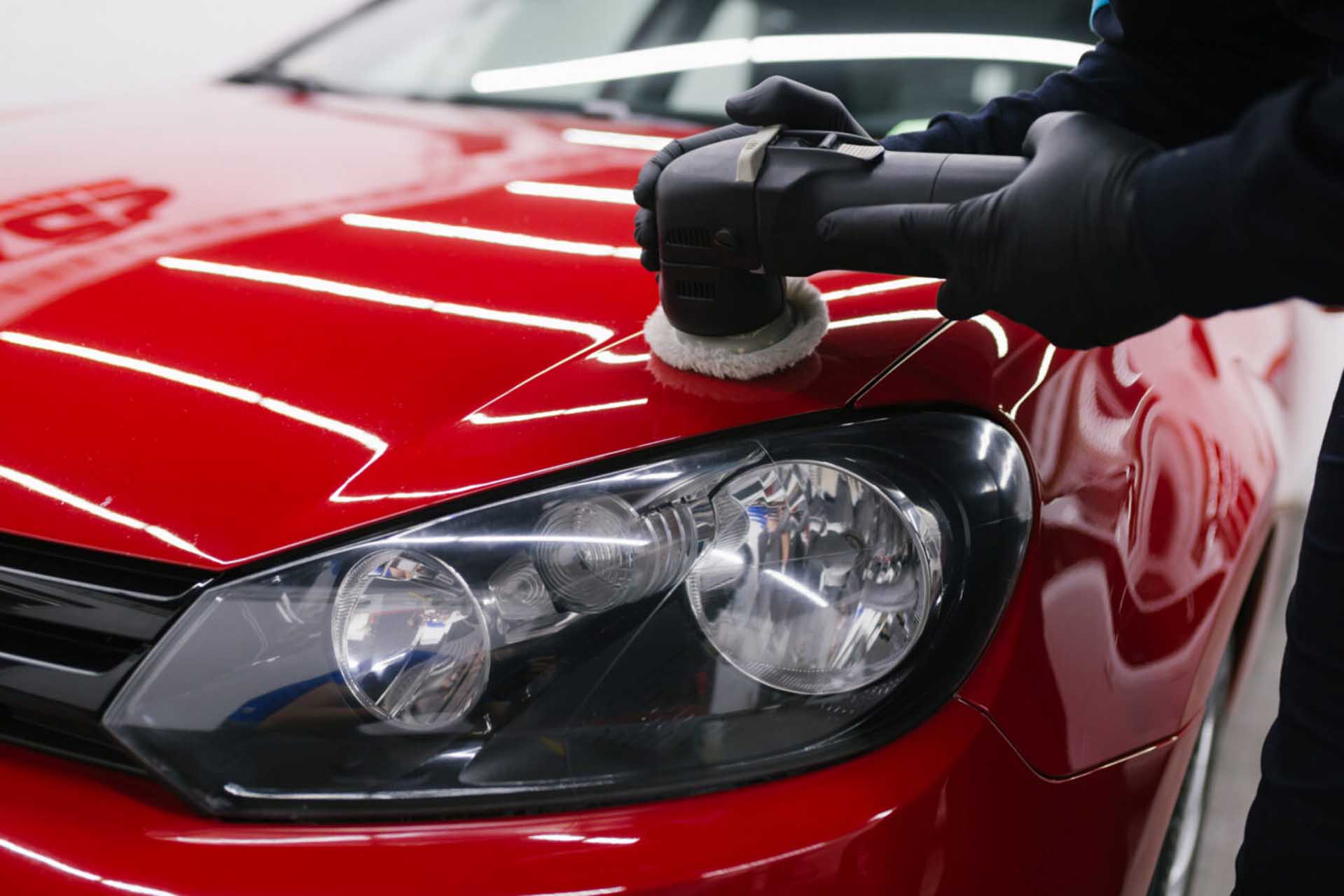
PDR is typically used when: dents are small to medium, the paint is unbroken, and the panel can be accessed from behind. This describes the majority of hail damage from typical storm events — dozens of shallow, round dents across the hood and roof, with paint intact. PDR is faster, costs less, and preserves the factory finish.
Conventional body repair becomes necessary when: dents are deep enough that the metal has stretched beyond what PDR can fully correct, the paint is cracked or chipped at the impact site, or the panel edge or body line is involved in the damage. Conventional repair means filler, sanding, primer, paint, and blending into adjacent panels.
A single hail event can require both methods on the same vehicle — PDR on the hood and roof where dents are shallow, conventional repair on a spot where a larger stone cracked the paint on a door panel.
What hail repair costs in the U.S.
Pricing varies significantly based on damage severity, number of panels affected, and repair method.
PDR for small individual dents runs $75 to $200 per dent. Moderate hail damage — more dents, some requiring more work — runs $200 to $350 per dent or $500 to $1,500 for a panel set. Severe hail damage involving multiple panels with high dent density can reach $2,000 to $7,500 or more for a full vehicle.
Conventional body repair with paint costs more: roughly $600 to $2,000 or more per panel depending on the vehicle, panel size, and how much blending adjacent panels require.
In South Florida, labor rates run above national averages, which pushes all of these figures toward the higher end of their ranges.
The most important variable is how widespread the damage is. A car with ten dents on one panel is a very different job — and a very different bill — than a car with forty dents across the roof, hood, and both front doors.
How comprehensive insurance handles hail damage
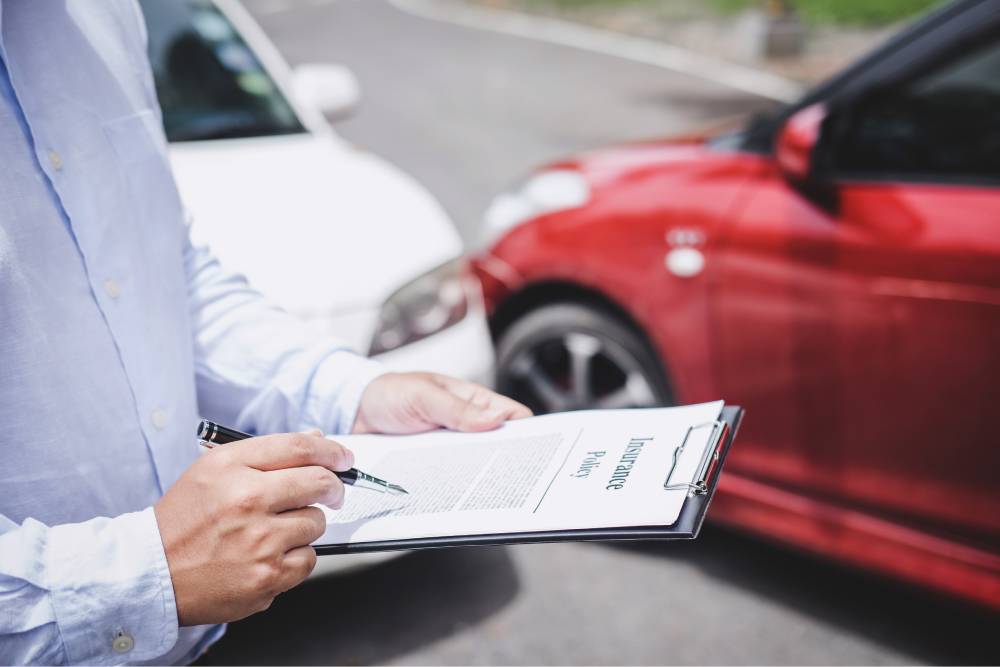
Hail damage is covered under comprehensive insurance, not collision. Comprehensive covers weather events, falling objects, theft, and vandalism — not accidents. If you only carry collision coverage, hail damage isn’t covered.
Filing a comprehensive claim for hail damage is usually treated differently from an at-fault collision claim, but the actual rate impact depends on your insurer and policy — it’s worth asking your agent before filing if that’s a concern.
The deductible math still applies. If your repair estimate is $800 and your comprehensive deductible is $500, you’d receive $300 from insurance. Filing a claim for that amount may not be worth the administrative effort or any policy effects. If the estimate is $4,000 and the deductible is $500, the calculation is straightforward.
One practical consideration: get the repair estimate before filing. Some drivers file immediately, then discover the damage is close to their deductible. Getting an accurate estimate first — including any hidden damage the inspection reveals — gives you the full picture before committing to a claim.
What to do after a hail storm
Inspect the car in good light as soon as it’s safe. Don’t wait days. Move the car into sunlight or under strong artificial light and walk the perimeter, looking at panels at low angles. Check the glass for chips or cracks. Check rubber seals around doors and windows.
Document everything with photos. Take wide shots of each panel and close-ups of individual dents and any paint or glass damage. Photograph from multiple angles. This documentation matters if you file an insurance claim — adjusters will want evidence of the damage’s scope before repair.
Don’t try to assess the full damage yourself. What you can see from outside the car is part of the picture. A professional inspection — which takes the glass, seals, and trim into account, not just the visible dents — gives you the complete scope. This matters both for repair planning and for insurance documentation.
Get the car inspected before hidden damage progresses. Compromised seals and glass chips can worsen quickly, especially in Florida’s heat and humidity. Water intrusion that starts small becomes a significantly larger problem if left for weeks.
Hail in South Florida: less frequent, but real
South Florida sees less hail than the Great Plains, but hail events do occur — typically from severe thunderstorms during the warmer months, concentrated inland rather than coastal. The flat, open terrain in parts of Miami-Dade and Broward counties provides less shelter from overhead storm activity than more built-up areas.
When hail does hit South Florida, the damage pattern is consistent with what’s described above: horizontal panels take the most impact, and the combination of heat and humidity means any paint or seal damage progresses faster than it would in a cooler, drier climate.
The seasonal pattern — June through October — aligns with Florida’s peak storm period. Parking in a garage or under a covered structure during that window is the most effective preventive measure available.
Common questions
Insurance policies typically require prompt notice after an accident — claim deadlines and lawsuit deadlines are different things. Report the damage as soon as possible and check your specific policy requirements rather than assuming a fixed window.
Generally yes, particularly for at-fault accidents. The increase varies by insurer, your history, and state regulations. In Florida, the impact can be significant — another reason to weigh the claim value against the potential premium effect before filing.
The insurance company may declare the vehicle a total loss. In that case, they pay you the actual cash value of the car, minus the deductible. You keep the car if you choose and receive a reduced payout, or you surrender it and receive the full actual cash value minus deductible.
Yes. If an unidentified driver damages your car and leaves, collision coverage applies to your vehicle’s repair, minus your deductible. This is one of the clearest cases for carrying collision regardless of your car’s age.
Yes — you don’t need to have witnessed the storm or know the exact date. Insurers assess the damage and the pattern of impacts, not necessarily the specific event timing. Document the damage as soon as you discover it.
PDR for moderate hail damage on one or two panels can be completed in a day. Full-vehicle hail repair with high dent density typically takes two to four days. Repairs requiring conventional bodywork on some panels take longer due to paint curing time.
Generally yes. Unrepaired hail damage is visible on inspection and reduces trade-in offers — dealers factor in the reconditioning cost they’ll need to spend. If the damage is moderate and PDR-eligible, the repair cost is often less than the reduction in sale price. Get an estimate first to make the math clear.
The dents themselves won’t spread. But if any paint is cracked or seals are damaged, the consequences — rust, water intrusion — can worsen over time. That’s why inspection is worthwhile even when the visible damage looks minor.
Look at horizontal panels — hood, roof, trunk — in direct sunlight at a low angle. Shallow dents appear as small dimples or distortions in the reflected light. Also check the windshield and rear glass for chips, and run your hand along rubber seals to feel for damage.
On a good PDR candidate — shallow dent, intact paint, accessible panel — the result is typically undetectable in normal light. Results are harder to guarantee on deep dents, aluminum panels, or dents near body lines, where the margin for a perfect outcome is smaller.
Hail damage repaired with PDR is typically covered under comprehensive insurance. Collision damage depends on your policy. In both cases, the deductible applies, and it’s worth comparing the repair cost against the deductible before filing.
Yes. Labor rates in South Florida tend to run higher than national averages, which means PDR pricing in the Miami area falls toward the upper end of the ranges above.
Usually yes — significantly so when the damage is a good PDR candidate. A door ding that costs $100–$150 with PDR can run $400–$700 through conventional repair involving filler, paint, and blending. The gap closes when PDR isn’t the right method for the damage, since a poor PDR result may still need conventional repair on top.
No. PDR works when the paint is intact, the metal hasn’t been overstretched, and the panel is accessible. Sharp creases, deep point impacts, and dents with cracked paint are typically better addressed through conventional body repair.
Higher-cost professional coatings typically use more concentrated chemistry, carry longer warranties, and require more skilled application. The difference between a $900 coating and a $1,500 coating is usually durability and warranty terms — both will produce similar results in year one. The gap shows up in years three and four.
Water beading that diminishes over time usually means the coating is degrading or has been compromised by incorrect washing products. A detailing shop can assess whether a maintenance topper will restore performance or whether the coating needs to be reapplied.
The gloss improvement and water beading are visible within days of application, once the coating has cured. The protection benefits — slower UV degradation, easier maintenance — show up over months and years.
Yes, but not easily. It requires machine polishing, which also removes some clear coat. Worth knowing before you apply it: it’s not reversible with a wash.
Not much, but it does require the right kind. Wash with a pH-neutral soap, avoid abrasive wash media, and skip drive-through automatic washes. The coating does most of the work; you just need to avoid products that strip it.
Professional-grade coatings typically carry two to five year warranties. Longevity depends on the coating product, how the car is washed — automatic car washes with brushes degrade coatings faster — and how much UV and environmental exposure the car sees.
After any repair involving the bumper, windshield, suspension, or body panels, assume calibration is worth checking. A pre-scan and post-scan with a diagnostic tool — standard practice at a properly equipped collision center — will show whether any ADAS fault codes are present before and after the repair.
In most cases, yes — when calibration is required as part of a covered collision repair, it should be included in the claim. The key is that the shop documents the calibration requirement clearly in the repair order. If a shop doesn’t include it, you have the right to ask why.
Static calibration for a single system typically takes 30 to 90 minutes. Dynamic calibration requires additional drive time. A multi-system calibration after significant repair can take half a day when pre- and post-scans are included. It’s not a quick add-on — it’s a procedure.
Technically yes — the car will drive. The risk is that safety systems designed to prevent accidents may not respond correctly when you need them. For a vehicle with active lane-keeping or automatic emergency braking, that’s a meaningful safety gap, not a minor inconvenience.
It depends on depth and shape, not size. A large but shallow dent with smooth edges is often a better PDR candidate than a small but sharp crease.
The opposite — PDR preserves resale value better than conventional repair because the factory paint remains untouched. Repainted panels show up on inspection reports and can reduce trade-in offers.
Yes. When done correctly on suitable damage, the metal returns to its factory position and stays there. The repair is as durable as the original panel.
A well-executed repair on a localized area is difficult to distinguish from the original finish in normal light. The limitation is paint matching on older vehicles — the factory color shifts over time, and blending gets harder as the car ages. A good shop blends into adjacent panels to account for this.
On most vehicles made after 2018, yes — if any sensor in or around the bumper is disturbed during removal or replacement, calibration is required. On some vehicles this is a static calibration done in-shop; on others it requires a dynamic calibration on the road. Your shop should be able to tell you which applies to your vehicle before the work starts.
Depends on the crack. Short cracks away from mounting points, with intact paint, can often be filled and refinished successfully. Long cracks, cracks through tabs, or cracks where the plastic has separated usually mean the cover should be replaced.
Yes. BMW, Mercedes-Benz, Audi, Porsche, Tesla, Lexus, Rolls-Royce, Bentley, and all luxury makes are a regular part of our hail damage repair work. Aluminum panels and complex paint finishes require specific technique and tooling — all standard at our shop.
No — PDR is viable when the paint surface is intact and the metal hasn’t been stretched beyond correction. Dents where the paint has cracked or stress-fractured require repainting after correction or panel replacement. Our technicians assess each dent individually before any work begins.
Most repairs completed entirely with PDR take 3–7 business days depending on the number of panels affected. Repairs requiring panel replacement and repainting take 7–14 days. We provide a timeline estimate after the full assessment is complete.
Yes — documenting the damage immediately after the event gives you the most accurate claim and the best outcome on scope approval. High claim volume after major storm events backs up both insurance processing and shop availability. Getting assessed and documented quickly puts you ahead of the backlog.
PDR does not affect your paint — it corrects dents from behind the panel without any sanding, filling, or repainting. The original factory finish is preserved entirely. Panel replacement requires repainting, which we perform using spectrophotometer color matching in our climate-controlled spray booth.
Yes — hail damage is covered under comprehensive auto insurance, not collision. If you carry comprehensive coverage, hail damage is a covered loss. We manage the complete claims process including full damage documentation, adjuster communication, and scope approval to ensure every affected panel is included in the approved claim.
Yes. We repair flood-damaged vehicles of all makes including Mercedes-Benz, BMW, Audi, Porsche, Tesla, Lexus, and all domestic and import makes. Luxury vehicles with complex electrical architectures and ADAS systems require thorough post-flood electrical diagnosis and recalibration — all standard as part of our flood damage repair process.
Assessment and drying typically take 3–5 days before repair scope is established. Moderate flood damage repair takes 2–4 weeks. Extensive damage requiring electrical component replacement and full interior restoration can take 4–6 weeks or longer depending on parts availability.
Common indicators include musty or mold odor, electrical malfunctions or warning lights, corrosion on underbody components, water stains on interior trim or carpeting, and moisture inside headlight or taillight housings. A professional assessment is the only way to establish the true condition — particularly in recently purchased used vehicles with unknown history.
Yes — significantly. Saltwater accelerates galvanic corrosion in aluminum and steel, degrades electrical connectors and wiring insulation, and penetrates rubber seals and adhesive bonds throughout the vehicle. Saltwater-exposed vehicles require corrosion neutralization treatment as a first step, and damage progression is faster and more extensive than equivalent freshwater exposure.
Yes — flood damage is covered under comprehensive auto insurance, not collision. If you carry comprehensive coverage, water damage from flooding, storm surge, or hurricane events is a covered loss. We manage the complete claims process including documentation, adjuster communication, and scope approval.
It depends on water depth and duration, water type (saltwater vs freshwater), and which systems were affected. Minor water intrusion that didn’t reach electrical components or the floor pan can often be fully repaired. Significant submersion — particularly saltwater — may result in a total loss determination once the full scope is assessed. We provide an honest assessment before any repair work is authorized.
Window tint blocks UV from entering the cabin and protects interior surfaces, but it has no effect on exterior paint. Paint protection requires an external barrier — wax, coating, or physical shade.
Every six to eight weeks to maintain meaningful UV protection. Florida heat breaks down wax significantly faster than the three-to-four-month timelines listed on most product labels, which are written for moderate climates.
It depends on the stage. Early hazing can be corrected with machine polishing. Once the clear coat starts peeling or flaking, the affected panels need to be repainted. There’s no product that reverses peeling clear coat.
Florida has one of the highest annual UV indexes in the continental US, combined with heat that regularly pushes surface temperatures past 150°F. That combination accelerates photo-oxidation — the process that breaks down clear coat — faster than in cooler or cloudier climates.
Run your finger across a clean, dry panel. If it feels rough or gritty, the paint needs decontamination first. If it feels smooth but looks dull in sunlight, swirl marks are the issue — that’s a polishing job, not a washing one.
Yes. Air drying lets minerals deposit as water evaporates. Chamois can drag contaminants across the surface. A clean, high-pile microfiber drying towel used with light pressure is the least damaging option for the clear coat.
Light swirl marks can be reduced with a dual-action polisher and a light cutting compound. Deep scratches that go through the clear coat require professional correction. Trying to hand-polish swirl marks with a foam applicator rarely produces meaningful results and can add more.
Dark colors show swirl marks and surface scratches more clearly than light colors because the contrast between the scratch and the surrounding paint is higher. The marks were probably there before the wash — clean paint just makes them more visible.
Technically yes. But any swirl marks, scratches, or oxidation under the coating will be sealed in and become permanent. Professional application always includes a correction step first.
It blocks UV rays more effectively than wax and doesn’t degrade in heat. It won’t make faded paint look new — that requires correction first — but it does slow UV oxidation on paint that’s already in good condition.
In Florida conditions, most waxes last six to eight weeks before the protection breaks down noticeably. Premium carnauba waxes may stretch to ten weeks in winter months, but summer heat shortens that window considerably.
For a daily driver that lives outside, yes. Florida’s UV exposure and humidity accelerate clear coat degradation faster than most states. Ceramic coating significantly slows that process and reduces long-term paint correction costs.
Yes. Electric vehicles — including Tesla, Porsche Taycan, BMW i-series, Mercedes EQS, and Audi e-tron — require specific high-voltage safety protocols before any structural work near the battery system begins. We follow established EV safety procedures on every electric vehicle repair.
Systems that commonly require recalibration include forward collision warning, automatic emergency braking, lane departure warning, adaptive cruise control, blind spot monitoring, and 360-degree camera systems. The specific systems affected depend on which components were disturbed during the repair.
Yes. Any repair that disturbs camera or radar sensor positions — windshield replacement, front or rear bumper repair, mirror replacement — requires post-repair recalibration before driver assistance systems function correctly. We perform recalibration as a standard step, not an add-on.
Yes. Every paint repair is applied in our climate-controlled spray booth and blended into adjacent panels. We use spectrophotometer analysis to capture the correct formula for your vehicle’s current paint condition — not just the factory code — ensuring a seamless result across the repaired area.
Yes. Matte and satin finishes require dedicated reduced-gloss clear coat applied at an exact sheen level — standard clear coat produces a visible difference immediately, and conventional polishing makes it worse. We apply the correct products and technique for every low-gloss finish.
We use spectrophotometer color matching to capture the correct formula for your vehicle’s specific paint code and current condition — accounting for UV aging and production variation between build dates. This applies to all finishes including Bespoke, Designo, Individual, Paint to Sample, Mulliner, and low-gloss matte finishes.
Yes. Aluminum body repair requires dedicated tooling, compatible adhesive systems, and completely separated work areas from steel repair — steel contamination on aluminum causes galvanic corrosion that develops silently and cannot be corrected after the fact. Carbon fiber components require individual assessment for delamination and fiber fracture before any repair approach is determined.
No. Manufacturer warranties do not require collision repairs to be performed at an authorized facility. You have the right to choose any qualified repair shop. What matters is that the shop understands your vehicle’s construction, uses OEM procedures, and performs post-repair diagnostics and ADAS recalibration where required.
Yes. We regularly repair Mercedes-Benz, BMW, Audi, Porsche, Lexus, Tesla, Rolls-Royce, Bentley, Maserati, Acura, Jaguar, Land Rover, Volvo, Genesis, and all domestic and import makes. Luxury vehicles present specific repair challenges — aluminum and mixed-material body structures, carbon fiber components, Bespoke and Paint to Sample finishes, and advanced driver assistance systems that require post-repair recalibration.
Yes. We source OEM or OEM-equivalent parts for every repair and advise on part grade before work begins. If your insurer approves aftermarket parts, we make sure you’re aware before any work starts — part grade matters, particularly on luxury and safety-critical components.
Yes. Every collision repair is followed by a post-repair diagnostic scan to confirm all vehicle systems are reading correctly before the vehicle is returned. This step catches any error codes or system issues that may have been triggered during the repair process.
Every repair starts with a structural measurement and diagnostic scan — not just a visual inspection. Modern vehicles can sustain internal structural displacement without visible surface damage. We use manufacturer measuring data and calibrated equipment to identify the full scope of damage before repair planning begins.
Minor paint and dent repairs typically take 3–5 business days. Moderate structural repairs take 7–14 days. More significant damage or repairs requiring OEM parts with longer lead times can take 2–4 weeks. We provide a timeline estimate before work begins and communicate proactively throughout.
It depends on your policy. Some policies approve OEM parts as standard; others default to aftermarket. We advise on part grade before any work begins and ensure you’re aware of what’s been approved — part grade matters, particularly on luxury and safety-critical components.
No. Florida law gives you the right to choose your own repair facility. Your insurer can recommend a shop, but cannot require you to use one. Choosing your own shop ensures the repair is done to the standard you expect — not the standard your insurer prefers.
Yes. Hit-and-run claims fall under your uninsured motorist coverage and require specific documentation to process correctly. We handle the full claims process on your behalf — damage assessment, documentation, adjuster communication, and scope approval.
Yes. We work directly with all major insurance providers and manage the complete claims process — damage documentation, adjuster communication, and scope approval — on your behalf. Florida law gives you the right to choose your own repair shop; your insurer cannot require you to use a specific facility.
Yes. We repair all domestic and import makes — from everyday sedans and SUVs to luxury, European, and exotic vehicles. Every repair follows the manufacturer’s OEM procedures regardless of make or model.
Our primary service area covers North Miami Beach, Aventura, North Miami, Biscayne Gardens, Ojus, Miami Gardens, and Ives Estates. We also serve drivers from across Miami-Dade County and the broader South Florida area.
We’re located at 15150 W Dixie Hwy, North Miami Beach, FL 33162 — easily accessible from Aventura, North Miami, Biscayne Gardens, Ojus, Miami Gardens, and Ives Estates via Biscayne Boulevard and surrounding corridors.
We handle the full range of collision and body repair — structural collision repair, paint matching and refinishing, paintless dent repair, bumper repair, scratch removal, paint correction, ceramic coating, PPF installation, and auto glass replacement. Every service is performed in-house at our North Miami Beach shop.
Yes. Miami-Dade records 17,000 to 21,000 hit-and-run incidents annually, and the I-95 corridor is one of the most common locations. We handle the complete claims process — documentation, adjuster communication, and scope approval — on your behalf.
Yes. Miami-Dade records 17,000 to 21,000 hit-and-run incidents annually, and the I-95 corridor is one of the most common locations. We handle the complete claims process — documentation, adjuster communication, and scope approval — on your behalf.
Located at 15150 W Dixie Hwy, North Miami Beach — 4 miles via Ives Dairy Road to US-1, approximately 8 minutes. The most direct route from Ives Estates without crossing into Miami traffic.
Ives Dairy Road connects I-95 to the US-1 coastal corridor, carrying commuter and retail traffic through a mix of residential neighborhoods and strip commercial. Merge conflicts at the I-95 ramps and turning conflicts along the commercial stretch produce consistent rear-end and side-impact damage — the most common collision scenarios for Ives Estates drivers.
Yes. Biscayne Boulevard is one of the most frequently reported hit-and-run corridors in Miami-Dade’s northeast. We handle the complete claims process — documentation, adjuster communication, and scope approval — including uninsured motorist situations where the other party drove off.
Biscayne Boulevard carries both regional through-traffic and dense local volume from North Miami’s commercial strips — a combination that produces rear-end impacts, sideswipe incidents, and pedestrian-related front-end damage at higher rates than lower-density corridors. Front-end damage on this corridor frequently involves ADAS sensor displacement that isn’t visible on the surface.
NE 125th Street is North Miami’s main east-west connector to I-95, feeding commuter volume onto Biscayne Boulevard where local and through-traffic compete for the same lanes. Stop-and-go signal cycles, turning conflicts, and pedestrian crossings at this intersection produce consistent rear-end and angle impacts — often involving front-end sensor displacement that requires post-repair ADAS recalibration.
Yes. Parking lot hits — at retail centers and shopping complexes — are among the most common scenarios we handle from Miami Gardens, including hit-and-run situations where the other party didn’t leave contact information.
High-speed multi-vehicle incidents on SR-826 typically produce significant structural damage that appears less extensive than it is — frame displacement and sensor displacement near bumpers often require a structural scan and post-repair ADAS recalibration before the vehicle is safe to drive.
Located at 15150 W Dixie Hwy, North Miami Beach — 8 miles via I-95 or NW 27th Avenue (SR-7), approximately 15 minutes. The same corridor Miami Gardens residents travel daily toward North Miami Beach.
A 45 mph arterial through dense residential development with heavy pedestrian activity and limited lighting — speeding, red-light running, and abrupt lane changes are the primary causes. Both serious angle impacts and everyday rear-end damage are common on this stretch.
High-speed merge conflicts on I-95 near the Ives Dairy exit produce significant rear-end and side-impact structural damage — often more extensive than it appears on the surface. At the Ives Dairy and US-1 intersection, stop-and-go traffic generates lower-speed rear-end impacts that frequently involve sensor displacement near bumpers requiring post-repair ADAS recalibration.
Yes. Hit-and-run claims fall under your uninsured motorist coverage and require specific documentation to process correctly. We handle the full claims process — damage assessment, documentation, adjuster communication, and scope approval. Miami-Dade records 17,000 to 21,000 hit-and-run incidents annually, and this type of claim is a regular part of what we handle for drivers in the Ojus area.
AutoBodyLab is located at 15150 W Dixie Hwy, North Miami Beach — approximately 3 miles from Ojus, a 7-minute drive south via US-1. It’s the nearest full-service collision center to the area with no need to drive into Miami traffic.
Ives Dairy Road is the main east-west connector between I-95 and the US-1 coastal corridor, carrying commuter volume from surrounding cities alongside retail traffic heading toward Aventura Mall. The combination of through-traffic at arterial speeds and local vehicles turning in and out creates consistent rear-end and angle collision risk — particularly at the I-95 ramp intersections where merge decisions happen in a short window.
Yes. Biscayne Boulevard is one of the corridors where hit-and-run incidents are most frequently reported in Miami-Dade’s northeast. We handle the complete claims process — documentation, adjuster communication, and scope approval — on your behalf.
Yes. North Miami has higher pedestrian activity than most surrounding cities — a function of its urban density, transit use, and walkable commercial corridors on Biscayne Boulevard and NE 125th Street. Front-end damage from pedestrian-involved incidents is a more frequent repair scenario here than in lower-density areas.
Located at 15150 W Dixie Hwy, North Miami Beach — 3 miles north via Biscayne Boulevard (US-1), approximately 7 minutes. The same corridor most North Miami residents drive daily.
Biscayne Boulevard carries regional through-traffic at arterial speeds alongside heavy local volume — NE 125th Street adds east-west commuter flow connecting I-95 to the coast. The combination of signal-cycle conflicts, turning vehicles, and pedestrian crossings at this intersection produces consistent rear-end and angle impacts, often with sensor displacement near bumpers that requires post-repair ADAS recalibration.
We manage the complete process — damage documentation, adjuster communication, and scope approval — on your behalf. Florida law gives you the right to choose your own repair shop, and we ensure the approved scope covers OEM parts, ADAS recalibration, and diagnostic scans where applicable.
Yes. Mercedes-Benz, BMW, Audi, Porsche, Tesla, Lexus, Rolls-Royce, and Bentley are a regular part of our work. Luxury vehicles require OEM parts, material-specific repair procedures, and ADAS recalibration — all standard at our shop.
AutoBodyLab is located at 15150 W Dixie Hwy, North Miami Beach — a 12-minute drive south on Biscayne Boulevard from Aventura Mall. Drop-off is straightforward with no need to cross into Miami traffic.
Biscayne Boulevard carries through-traffic between Miami and Fort Lauderdale alongside heavy local volume from Aventura Mall, Turnberry Isle, and the William Lehman Causeway. The most common damage patterns are rear-end impacts in stop-and-go traffic and sideswipe incidents during lane changes — typically bumper, panel, and paint damage that looks minor but can involve sensor displacement requiring ADAS recalibration.
Yes. Lexus collision repairs are covered under standard comprehensive and collision insurance policies. Safety System+ recalibration, pre- and post-repair diagnostic scans, and OEM parts are legitimate repair line items that should be included in the approved claim. AutoBodyLab works directly with all major insurers and ensures these items are documented and covered — not reduced or omitted without the owner’s awareness.
Yes. AutoBodyLab handles Lexus body shop repairs for all Lexus models, including IS F Sport, RC F, LC F, and GS F performance variants. F models feature sport-specific body panels, unique exterior trim, and F-exclusive paint colors that require accurate pattern matching and color reproduction. We assess each F model repair individually and source OEM parts to the correct F-specification.
Lexus Safety System+ (LSS+) is Lexus’s standard driver assistance suite, which includes Pre-Collision System with Pedestrian Detection, Lane Departure Alert with Steering Assist, Automatic High Beams, and Radar Cruise Control with Lane Tracing Assist. These systems depend on a forward-facing camera mounted to the windshield and a millimeter-wave radar unit in the front bumper. Any repair that replaces the windshield, front bumper, or components near those sensors requires recalibration — otherwise the systems operate on misaligned reference data and may not activate correctly.
Yes. Sonic Titanium and other Lexus multi-layer effect finishes require spectrophotometer analysis to capture the correct pigment formula and particle orientation for your vehicle’s specific paint code and current condition. Standard code lookups don’t account for UV shift or production variation between build dates. All paint is applied in our climate-controlled spray booth and blended into adjacent panels for a seamless result.
Timeline depends on the extent of damage. Minor panel and paint repairs typically take three to five days. Moderate structural repairs involving panel replacement and paint take one to two weeks. More significant structural damage — particularly involving TNGA ultra-high-strength steel zones with multiple Safety System+ recalibrations — can take two to three weeks or longer. Parts availability for specific Lexus models and trim levels can affect lead times, and we communicate proactively throughout the process.
No. Lexus’s warranty does not require collision repairs to be performed at an authorized facility. You have the right to choose any qualified repair shop. What matters is that the shop understands Lexus’s TNGA platform construction, uses OEM or OEM-equivalent parts, follows Lexus repair procedures — including approved sectioning locations for ultra-high-strength steel zones — and performs post-repair diagnostics and Safety System+ recalibration where required. AutoBodyLab regularly repairs Lexus vehicles and follows OEM repair procedures at our North Miami Beach shop.
Yes. Acura collision repairs are covered under standard comprehensive and collision insurance policies. AcuraWatch recalibration, pre- and post-repair diagnostic scans, and OEM parts are legitimate repair line items that should be included in the approved claim. AutoBodyLab works directly with all major insurers and ensures these items are documented and covered — not reduced or omitted without the owner’s awareness.
Yes. AutoBodyLab handles Acura body shop repairs for all Acura models including the NSX. The NSX uses a unique aluminum and carbon fiber space frame with a mid-engine layout — a construction that requires individual assessment after any significant impact. Carbon fiber components are evaluated for structural integrity before a repair approach is determined. Paint matching for NSX-specific colors follows the same spectrophotometric process as all other Acura models.
Yes. Performance Red Pearl and other multi-layer effect finishes require spectrophotometer analysis to capture the correct formula for your vehicle’s specific paint code and current condition. The pearl layer density and pigment composition are measured directly from your car’s existing paint rather than relying on a standard code lookup, which may not account for UV shift since the vehicle was built. All paint is applied in our climate-controlled spray booth and blended into adjacent panels for a seamless result.
ACE stands for Advanced Compatibility Engineering — a Honda/Acura body structure design that uses multiple load paths to distribute crash energy across the frame rather than concentrating it. This improves protection for occupants in offset and vehicle-to-vehicle collisions. For repair purposes, it means that structural zones affected by a collision need to be assessed and restored accurately, not just the visibly deformed areas. Ultra-high-strength steel zones within the ACE structure also cannot be heat-straightened — they must be replaced at approved sectioning points.
Timeline depends on the extent of damage. Minor panel and paint repairs typically take three to five days. Moderate structural repairs involving panel replacement and paint take one to two weeks. More significant structural damage involving ultra-high-strength steel zones and AcuraWatch recalibration can take two to three weeks. Parts availability for specific Acura models and trim levels can affect lead times, and we communicate proactively throughout the process.
No. Acura’s warranty does not require collision repairs to be performed at an authorized facility. You have the right to choose any qualified repair shop. What matters is that the shop understands the ACE body structure’s load-path engineering, uses OEM or OEM-equivalent parts, follows Acura repair procedures including approved sectioning locations, and performs post-repair diagnostics and AcuraWatch recalibration where required. AutoBodyLab regularly repairs Acura vehicles and follows OEM repair procedures at our North Miami Beach shop.
It depends on the damage. Surface-level impacts where the carbon fiber structure is intact can sometimes be addressed without full replacement. Cracks, delamination, or fractures in the structural fiber layer require replacement rather than repair — CFRP that has failed structurally cannot be safely restored by filling or resurfacing. We assess each CFRP component individually, advise on the correct approach, and source OEM replacement parts where replacement is the right path.
Yes. Maserati collision repairs are covered under standard comprehensive and collision insurance policies. Driver assistance recalibration, pre- and post-repair diagnostic scans, OEM parts, and CFRP component assessment are legitimate repair line items that should be included in the approved claim. AutoBodyLab works directly with all major insurers and ensures these items are documented and covered — not reduced or omitted without the owner’s awareness.
Yes. AutoBodyLab handles Maserati collision repair for all current models including the MC20 mid-engine supercar. The MC20’s carbon fiber monocoque chassis requires specialist assessment after any significant impact — we evaluate each component for structural integrity before determining the correct repair approach. Paint matching for MC20-specific colors and finishes follows the same spectrophotometric process as all other Maserati models.
Yes. Standard Maserati metallics and solids are matched using spectrophotometer analysis against your vehicle’s specific paint code and current condition. Low-gloss finishes such as Grigio Granito Opaco require dedicated reduced-gloss clear coat — standard clear coat is not compatible and will produce a visible sheen difference. All paint is applied in our climate-controlled spray booth and blended into adjacent panels for a seamless result.
Timeline depends on the scope of damage and the model. Minor panel and paint repairs typically take three to five days. Moderate structural repairs involving panel replacement and paint take one to two weeks. Significant structural damage — particularly on MC20 or GranTurismo models involving CFRP assessment and multiple ADAS recalibrations — can take two to four weeks or longer depending on parts availability. We communicate proactively throughout the process.
No. Maserati’s warranty does not require collision repairs to be performed at an authorized facility. You have the right to choose any qualified repair shop. What matters is that the shop understands Maserati’s mixed-material construction, uses OEM or OEM-equivalent parts, follows Maserati repair procedures, and performs post-repair diagnostics and driver assistance recalibration where required. AutoBodyLab regularly repairs Maserati vehicles and follows OEM repair procedures at our North Miami Beach shop.
Yes. Bentley collision repairs are covered under comprehensive and collision insurance policies. OEM parts, Mulliner paint reproduction, driver assistance recalibration, and pre- and post-repair diagnostic scans are legitimate repair line items that should be documented and included in the approved claim. AutoBodyLab works directly with all major insurers and specialist high-value vehicle underwriters to ensure the full scope is approved and covered — not reduced or approximated without the owner’s awareness.
Yes. AutoBodyLab handles Bentley auto body repair for all current models — Continental GT, Continental GT Convertible, Flying Spur, Bentayga, and Bentayga Extended Wheelbase — including Mulliner specification variants. Mulliner models require attention to bespoke paint colors, two-tone finishes, and individually specified exterior details. We assess each Mulliner repair individually and approach the paint and finish work based on the specific vehicle rather than a standard reference.
Yes. Continental GT and Flying Spur models use aluminum for doors, hood, and front fenders on most variants, while structural sills, pillars, and certain underbody components use high-strength steel. The MSB platform’s mix of materials requires dedicated aluminum tooling and completely separated work areas from steel repair — steel contamination on aluminum causes galvanic corrosion that develops over time at repair points. Our technicians identify panel material before starting and apply the correct procedure for each surface.
Yes. Mulliner two-tone finishes divide the body at a precise horizontal line, with each color requiring accurate formula reproduction and a clean transition at the split. We use spectrophotometer analysis to capture the correct formula for each color from your vehicle’s existing paint, accounting for UV aging and production variation. Paint is applied in our climate-controlled spray booth and the two-tone transition is reproduced to match the original specification. Where a repair affects the split line, we assess the full transition and advise on the correct restoration approach.
No. Bentley’s warranty does not require collision repairs to be performed at an authorized facility. You have the right to choose any qualified repair shop. What matters is that the shop understands the MSB platform’s multi-material construction, sources correct OEM supply chain parts, has experience with Mulliner paint specifications, and performs post-repair diagnostics and driver assistance recalibration where required. AutoBodyLab regularly repairs Bentley vehicles and follows OEM repair procedures at our North Miami Beach shop.
Timeline depends on the scope of damage and the complexity of the vehicle’s specification. Minor panel repairs typically take one to two weeks, accounting for OEM parts sourcing lead times. Moderate structural repairs take two to three weeks. Significant damage involving Mulliner paint reproduction, two-tone finishes, or multiple ADAS recalibrations can take three to five weeks or more. We provide a detailed timeline estimate before work begins and communicate proactively throughout the process.
Yes. Rolls-Royce collision repairs are covered under comprehensive insurance policies. High-value vehicle specialists and standard insurers alike cover structural repair, paint restoration, and ADAS recalibration — though the approved scope requires careful documentation to ensure Bespoke paint reproduction, coachline restoration, and OEM parts are included rather than approximated. AutoBodyLab works directly with all major insurers and specialist high-value vehicle underwriters to ensure the full repair scope is approved and covered.
Yes. Rolls-Royce collision repairs are covered under comprehensive insurance policies. High-value vehicle specialists and standard insurers alike cover structural repair, paint restoration, and ADAS recalibration — though the approved scope requires careful documentation to ensure Bespoke paint reproduction, coachline restoration, and OEM parts are included rather than approximated. AutoBodyLab works directly with all major insurers and specialist high-value vehicle underwriters to ensure the full repair scope is approved and covered.
Yes. Rolls-Royce coachlines are applied by hand at the factory using a fine brush technique, and restoring them after a panel repair requires the same approach. We match the coachline color using spectrophotometric analysis, reproduce the line width and position from the existing coachline on the unaffected sections of the vehicle, and apply by hand to maintain consistency with the original. Where the repair affects the full length of a coachline, we assess the full line and advise on the correct restoration approach.
Yes, in most cases. Bespoke colors have no standard formula on file — they are specified individually for each vehicle. Reproducing them requires spectrophotometric analysis of the actual painted panel to capture the correct pigment composition, particle size, and layer structure for that specific car. Our technicians take readings directly from the vehicle’s existing paint, mix to those measurements, and apply in our climate-controlled spray booth. The result is matched to the vehicle’s current paint condition — accounting for any UV shift since original delivery.
Timeline depends on the scope of damage and the complexity of Bespoke specification. Minor panel repairs typically take one to two weeks — longer than standard vehicles due to parts sourcing through the Rolls-Royce supply chain and Bespoke paint reproduction. Moderate structural repairs take two to four weeks. Significant damage involving multiple panels, two-tone paint, coachline restoration, and ADAS recalibration can take four to six weeks or more. We provide a detailed timeline estimate before work begins and communicate proactively throughout.
No. Rolls-Royce’s warranty does not require collision repairs to be performed at an authorized facility. You have the right to choose any qualified repair shop. What matters is that the shop understands the all-aluminum spaceframe construction, has experience with Bespoke paint reproduction, uses correct OEM supply chain parts, and performs post-repair diagnostics and driver assistance recalibration where required. AutoBodyLab regularly repairs Rolls-Royce vehicles and follows OEM repair procedures at our North Miami Beach shop.
Yes. Porsche collision repairs are covered under standard comprehensive and collision insurance policies. InnoDrive recalibration, pre- and post-repair diagnostic scans, and OEM parts are legitimate repair line items that should be included in the approved claim. AutoBodyLab works directly with all major insurers and ensures these items are documented and covered — not reduced or omitted without the owner’s awareness.
Yes. AutoBodyLab handles Porsche collision repair for all Porsche models, including the Taycan and Taycan Cross Turismo. Taycan repairs follow standard Porsche structural and finish procedures, with the addition of high-voltage battery system safety protocols for any work near the floor assembly. InnoDrive and ADAS recalibration is performed as standard on all Taycan collision repairs involving sensor-adjacent components.
It depends on the damage. Surface-level damage to CFRP panels — such as paint chips, minor scuffs, or shallow impacts where the fiber structure is intact — can often be addressed without full panel replacement. Cracks, delamination, or impact fractures that compromise the structural layer of the carbon fiber require replacement rather than repair. We assess each CFRP component individually, advise on the correct approach, and source OEM replacement parts where needed.
Yes. PTS colors are individual finishes without a standard formula on file — matching them requires spectrophotometric analysis of the actual painted panel to capture the correct pigment mix and application characteristics for that specific vehicle. Our technicians take readings directly from your car’s existing paint, mix to those measurements, and apply in our climate-controlled spray booth. The result is matched to your vehicle’s current paint condition, not a generic code that may have drifted from the original application.
No. Porsche’s warranty does not require collision repairs to be performed at an authorized facility. You have the right to choose any qualified repair shop. What matters is that the shop understands Porsche’s multi-material construction, uses OEM or OEM-equivalent parts, follows Porsche repair procedures, and performs post-repair diagnostics and InnoDrive recalibration where required. AutoBodyLab regularly repairs Porsche vehicles and follows OEM repair procedures at our North Miami Beach shop.
Timeline depends on the scope of damage. Minor panel and paint repairs typically take three to five days. Moderate structural repairs involving panel replacement and paint take one to two weeks. Significant structural damage — particularly on 911 or GT models with aluminum and CFRP components requiring multiple ADAS recalibrations — can take two to three weeks or longer. Parts availability for specific Porsche models and configurations can affect lead times, and we communicate proactively throughout the process.
No. Audi’s warranty does not require collision repairs to be performed at an authorized facility. You have the right to choose any qualified repair shop. What matters is that the shop understands Audi’s Aluminum Space Frame construction, uses OEM or OEM-equivalent parts, follows Audi repair procedures, and performs post-repair diagnostics and Pre Sense recalibration where required. AutoBodyLab regularly repairs Audi vehicles and follows OEM repair procedures at our North Miami Beach shop.
Yes. Audi collision repairs are covered under standard comprehensive and collision insurance policies. Audi Pre Sense recalibration, pre- and post-repair diagnostic scans, and OEM parts are legitimate repair line items that should be included in the approved claim. AutoBodyLab works directly with all major insurers and ensures these items are documented and covered — not reduced or omitted without the owner’s awareness.
Yes, in some cases. ASF repairs require aluminum-specific tooling, compatible adhesives, and in some cases specialized joining equipment that isn’t needed for steel-body repairs. This can affect both cost and timeline compared to a comparable repair on a conventional vehicle. The benefit is a more accurate structural restoration — one that maintains the original crash performance and corrosion protection the vehicle was designed with. We assess each repair individually and provide a detailed estimate before any work begins.
Yes. AutoBodyLab handles Audi body shop repairs for all Audi variants — standard A and Q models, S performance variants, RS high-performance models, and Audi e-tron and Q4 e-tron electric vehicles. RS models require attention to widened body panels, performance-specific components, and RS-exclusive paint colors. Audi e-tron models add high-voltage system proximity protocols to any structural repair near the floor assembly, consistent with our EV repair procedures.
Timeline depends on the extent of damage. Minor panel and paint repairs typically take three to five days. Moderate structural repairs involving panel replacement and paint take one to two weeks. More significant structural damage — particularly on ASF models requiring aluminum component replacement and multiple ADAS recalibrations — can take two to three weeks or longer. Parts availability for specific Audi models and trim levels can affect lead times, and we communicate proactively throughout the process.
Yes. Nardo Grey is a distinctive flat finish that requires careful texture and gloss matching at blend edges — any variation in sheen level reads immediately in sunlight. RS colors including Kyalami Green and Kemora Grey are matched using spectrophotometer analysis against your vehicle’s specific paint code and current paint condition. All paint is applied in our climate-controlled spray booth and blended into adjacent panels for a seamless result.
Yes. BMW collision repairs are covered under standard comprehensive and collision insurance policies. ADAS recalibration, pre- and post-repair diagnostic scans, and OEM parts are legitimate repair line items that should be included in the approved claim. AutoBodyLab works directly with all major insurers and ensures these items are documented and covered — not reduced or omitted without the owner’s awareness.
Yes. AutoBodyLab handles BMW body shop repairs for all BMW variants — standard 3, 4, 5, 7, and 8 Series, X3 through X7, M performance models, and BMW i electric vehicles including i4, i5, and iX. M models require attention to CFRP components, wider body panels, and M-specific paint colors. BMW i models add high-voltage system proximity protocols to any structural repair near the floor assembly, consistent with our EV repair procedures.
It depends on the damage. Carbon fiber reinforced plastic (CFRP) components — such as M3 and M4 roof panels, carbon fiber mirror caps, and trim elements — can sometimes be repaired if the damage is surface-level and the structural integrity of the component is intact. Cracked, delaminated, or impact-fractured CFRP typically requires replacement rather than repair. We assess each component individually and advise on the correct approach before any work begins.
Timeline depends on the extent of damage. Minor panel and paint repairs typically take three to five days. Moderate structural repairs involving panel replacement and paint take one to two weeks. More significant structural damage — or repairs involving CFRP components and multiple ADAS recalibrations — can take two to three weeks or longer. Parts availability for specific BMW models and trim variants can affect lead times, and we communicate proactively throughout the process.
Yes. Frozen finishes require dedicated matte clear coat products and application technique — standard clear coat cannot be used, and conventional polishing is not compatible with the surface. We match Frozen colors using spectrophotometer analysis and apply the correct matte clear coat to maintain the original texture and sheen level. Individual colors are matched to your vehicle’s specific paint code and current paint condition. All paint work is performed in our climate-controlled spray booth.
No. BMW’s warranty does not require collision repairs to be performed at an authorized facility. You have the right to choose any qualified repair shop. What matters is that the shop understands BMW’s multi-material construction, uses OEM or OEM-equivalent parts, follows BMW repair procedures, and performs post-repair diagnostics and ADAS recalibration where required. AutoBodyLab regularly repairs BMW vehicles and follows OEM repair procedures at our North Miami Beach shop.
Yes. Mercedes-Benz collision repairs are covered under standard comprehensive and collision insurance policies. ADAS recalibration, pre- and post-repair diagnostic scans, and OEM parts are legitimate line items that should be included in the approved claim. AutoBodyLab works directly with all major insurers and ensures these items are documented and covered — not reduced or omitted without the owner’s awareness.
Yes. AutoBodyLab handles Mercedes body shop repairs for all MB variants — standard C, E, S, GLC, GLE, and GLS models, AMG performance variants, and EQ electric vehicles. AMG models require attention to carbon fiber and aerodynamic components where fitted. EQ vehicles add high-voltage system proximity protocols to the repair process, consistent with our EV repair procedures.
Yes. Designo colors and Mercedes’ premium metallic finishes require additional application stages and precise blending technique. We use spectrophotometer color matching to capture the exact formula for your vehicle’s specific paint code and production date. All paint is applied in our climate-controlled spray booth and blended into adjacent panels — the result is seamless and consistent with the original finish standard.
Timeline depends on the scope of damage. Minor panel and paint repairs typically take three to five days. Moderate structural repairs involving panel replacement and paint take one to two weeks. Significant structural damage with multiple ADAS recalibrations can take two to three weeks or more. Parts availability for certain MB models and trim levels can affect lead times — we communicate proactively throughout the process.
Not without your knowledge. At AutoBodyLab, we advise on parts grade before any Mercedes-Benz collision repair begins and source OEM or OEM-equivalent components as the default. If your insurer approves aftermarket parts, we flag it and work with you to ensure the correct specification is used where it matters — particularly for structural components and panels with tight fit tolerances.
No. Mercedes-Benz’s warranty does not require repairs to be performed at an authorized collision center. You have the right to choose any qualified repair facility. What matters is that the shop has experience with Mercedes-Benz construction, uses OEM or OEM-equivalent parts, follows MB repair procedures, and performs the required post-repair diagnostics and ADAS recalibration. AutoBodyLab meets all of those requirements as a specialist Mercedes-Benz body shop in North Miami Beach. AutoBodyLab regularly repairs Mercedes-Benz vehicles and follows OEM repair procedures.
Yes. Tesla collision repairs are covered under standard comprehensive and collision insurance policies. Tesla-specific costs — including diagnostic scans and Autopilot sensor recalibration — are legitimate repair line items that should be included in the approved claim. AutoBodyLab works directly with all major insurers and ensures these items are documented and covered, not absorbed by the owner.
Yes. AutoBodyLab provides Tesla body shop services for all current models: Model 3, Model Y, Model S, Model X, and Cybertruck. Each model has specific structural and finish characteristics — Model S and X use more extensive aluminum framing, while Cybertruck introduces stainless steel exoskeleton repair requirements. We assess each vehicle individually and apply the correct repair approach for that model.
Collision repairs performed correctly — following Tesla’s repair procedures and documentation requirements — do not void the battery or drivetrain warranty. What can affect the warranty is incorrect repair technique: using steel tools on aluminum panels, improper welding near battery components, or failure to reset and document system calibrations after the repair. Our Tesla collision center process follows Tesla’s repair standards at every stage.
Yes. Pearl White Multi-Coat is a tri-layer finish — primer, base, and pearl layer — and one of the more technically demanding Tesla colors to blend at panel edges. We use spectrophotometer color matching to capture the exact formula for your vehicle’s specific build date and UV aging level. Paint is applied in our climate-controlled booth in the correct layer sequence, and panels are blended into adjacent surfaces for a seamless result.
Timeline depends on the scope of damage. Minor panel and paint repairs on a Tesla typically take three to five days. Moderate structural repairs involving aluminum replacement and paint take one to two weeks. Significant structural damage with multiple system recalibrations can take two to three weeks or longer. Parts availability for certain Tesla models can affect timeline — we communicate proactively on lead times before and during the repair.
No. Tesla’s warranty does not require you to use a Tesla-approved collision center for body repairs. You have the right to choose any qualified repair facility. What matters is that the shop has the correct equipment for aluminum and high-strength steel repair, follows Tesla’s repair procedures, and performs the required post-repair diagnostics and sensor recalibration. At AutoBodyLab, we meet all of those requirements as a specialist Tesla body shop in North Miami Beach.
Yes. AutoBodyLab is a full-service custom paint shop near me serving North Miami Beach, Aventura, Sunny Isles, Hallandale, and North Miami. We handle custom colors, custom car graphics, special finishes, and full custom builds entirely in-house. Contact us to schedule a design consultation and discuss your project.
Yes. AutoBodyLab handles custom auto paint on all vehicle classes — daily drivers, muscle cars, luxury sedans, SUVs, and exotic vehicles. High-value vehicles receive the same controlled environment, documented process, and certification-backed workmanship as every other job in our shop. We understand the standards these vehicles require and work accordingly.
Yes. Custom car graphics can be applied to specific panels or areas without disturbing the rest of the vehicle’s finish. Painted graphics are masked directly onto the existing clear coat and shot in-booth, then re-cleared. Vinyl graphics are applied over the existing paint with no sanding or primer required. Both options are available depending on the client’s preference for permanence.
Yes. Our custom auto paint shop mixes colors in-house to specification. If you have a reference — a color swatch, a pantone number, a photograph, or a sample — we can formulate a match and test-spray it before committing to the full application. Custom formulations are documented so future touch-ups stay consistent.
It depends on the vehicle and the market. On specialty cars, classic builds, and show vehicles, a high-quality custom paint job near me done by a reputable shop often adds value. On daily drivers, a non-standard color can narrow the buyer pool. We’re happy to discuss the resale implications of different options at the consultation stage so you can make an informed decision.
The timeline for a custom car paint job depends on the scope: the number of panels, the complexity of the finish, and whether bodywork or graphic masking is involved. A single-panel custom color typically takes two to three days. A full vehicle custom paint with graphics can take one to two weeks. We provide a clear timeline at the consultation stage before any work begins.
Yes. AutoBodyLab is a certified PPF installer near me serving North Miami Beach, Aventura, Sunny Isles, Hallandale, and North Miami. We install professional-grade paint protection film near me on all vehicle types — from daily drivers to luxury and exotic cars. Contact us to schedule a paint assessment and get a recommendation based on your vehicle and coverage goals.
A partial front PPF installation typically takes one day. A full front package takes one to two days. A full body installation on a standard vehicle requires two to four days depending on panel count and complexity. All installations are performed in our controlled indoor environment to prevent dust contamination during application.
Yes — combining paint protection film with a ceramic coating applied over it gives you the most comprehensive protection available. The PPF handles physical impact; the ceramic coating on top adds hydrophobic performance, UV resistance, and makes the film surface significantly easier to clean and maintain. It’s the setup most commonly chosen for new vehicles and high-value cars.
Yes. Professional-grade paint protection film is designed to be removable without damaging the underlying paint, provided it’s removed correctly using heat and proper technique. Film that has been left on beyond its rated lifespan or that was applied over compromised paint can be more difficult to remove cleanly. Our certified PPF installers handle both installation and removal.
High-quality PPF film is optically clear and virtually undetectable on the vehicle. When installed correctly with properly tucked edges, the film is invisible in normal lighting conditions. Matte PPF is also available for vehicles with matte or satin paint finishes, preserving the factory appearance while providing the same level of physical protection.
Professional-grade paint protection film installed by certified technicians typically lasts between five and ten years, depending on the product tier, maintenance, and environmental exposure. In Florida’s UV-heavy climate, high-quality film with UV inhibitors is essential to prevent yellowing and adhesive degradation over time. All film products we install carry a manufacturer warranty.
A ceramic car coating adds hardness to the clear coat surface and provides resistance against light surface marring and swirl marks from washing. However, it is not scratch-proof. Deep scratches, stone chips, and keying will still penetrate the coating. For scratch and impact protection, paint protection film (PPF) is the appropriate solution — and the two are often combined.
Yes. AutoBodyLab provides professional ceramic coating near me services across North Miami Beach, Aventura, Sunny Isles, Hallandale, and North Miami. We apply coating to paint, wheels, and glass on all vehicle types — from daily drivers to luxury and exotic cars. Contact us to schedule a paint assessment and get a recommendation based on your vehicle’s current condition.
No. Ceramic coating locks in the condition of the paint at the time of application. Any swirl marks, oxidation, or scratches present will be sealed under the coating and become significantly harder to correct without removing it first. Paint correction must be performed before coating to ensure a clean, defect-free surface is being protected.
Florida’s year-round UV exposure, hard water, humidity, and road contaminants make it one of the most demanding environments for automotive paint. A ceramic coating addresses all of those factors directly — blocking UV radiation, repelling hard water minerals before they etch, and making contaminant removal effortless. For a vehicle kept outdoors, it’s among the most practical paint protection investments available.
A full professional ceramic coating application — including decontamination, paint correction if needed, and coating — typically takes one to three days depending on the vehicle size and paint condition. The coating itself requires a curing period of 24–48 hours before the vehicle should be exposed to water or contaminants.
A professionally applied ceramic coating for cars protects against UV oxidation, hard water mineral etching, bird droppings, tree sap, road tar, industrial fallout, and light surface contamination. It does not protect against deep scratches, stone chips, or physical impact — those require paint protection film (PPF) or conventional repair.
Yes. AutoBodyLab handles all auto glass replacement — front windshields, side door glass, quarter glass, and rear windshield replacement — on all makes and models. Rear windshields with defroster grids, antenna elements, and camera integration are replaced to the full original specification and tested before delivery. Side windows are typically completed same-day.
Florida law requires insurance companies to waive the deductible on windshield repairs for policyholders with comprehensive coverage — meaning chip and crack repairs are fully covered at no cost. Full windshield replacement is also covered under comprehensive policies, though deductible terms vary. AutoBodyLab works directly with all major insurers and handles the claim process in-house. We also ensure ADAS recalibration costs are included when applicable.
For most vehicles, OEM-equivalent glass from a certified aftermarket manufacturer meets the same specifications as the original and is the standard choice for insurance-covered replacements. OEM glass — sourced from your vehicle’s original supplier — is recommended for vehicles with advanced ADAS integration or where exact optical clarity is critical. We advise on the right specification for your vehicle and ensure whatever glass is installed is fully compatible with your car’s embedded features.
Yes, if your vehicle has ADAS features — lane departure warning, automatic emergency braking, adaptive cruise control — the forward camera mounted to the windshield must be recalibrated after every car windshield replacement. Without recalibration, these systems operate on incorrect reference data and may not activate correctly. We perform ADAS recalibration in-house and include it in every windshield job on equipped vehicles.
Small chips and short cracks — typically under three inches and not in the driver’s direct line of sight — can often be repaired with a resin injection process rather than a full auto glass replacement. The repair restores structural integrity and prevents the crack from spreading, though a faint mark usually remains. Cracks longer than three inches, cracks that reach the edge of the glass, or damage in the driver’s sightline require full replacement.
A standard windshield replacement takes approximately one to two hours for the physical installation. However, the urethane adhesive requires a cure period of one to three hours before the vehicle can be safely driven — longer in humid conditions. If ADAS recalibration is required, add an additional one to two hours. We provide a complete timeline estimate when you book.
Yes. AutoBodyLab provides professional paint correction near me services across North Miami Beach, Aventura, Sunny Isles, Hallandale, and North Miami. We work on all vehicle types — sedans, SUVs, pickup trucks, luxury vehicles, and exotic cars. Contact us to schedule an assessment and get a quote based on your vehicle’s current paint condition.
The corrected finish is permanent — the defects that were removed do not return. However, new contamination will begin to accumulate immediately if the surface isn’t protected. Applying a ceramic coating after paint correction significantly extends how long the surface stays clean and defect-free, particularly in Florida’s UV-heavy climate.
When performed correctly, car paint correction removes only the minimum amount of clear coat needed to reach below the defects. A modern clear coat is typically 40–60 microns thick, and a professional correction removes only a few microns. Our technicians use a paint depth gauge before and during the process to ensure the clear coat remains at a safe thickness throughout.
No. Waxing and detailing products fill in defects temporarily with oils and fillers — the scratches and swirls are still there, just masked. Paint correction physically removes a controlled amount of clear coat to eliminate defects permanently. The result lasts
significantly longer and produces a level of clarity that wax-based products can’t replicate.
A single-stage paint correction on a standard vehicle typically takes four to eight hours. A full two-stage correction on a larger vehicle or one with heavy defects can take one to two days. Every job is inspected under calibrated lighting before completion to ensure all defects have been fully addressed.
Professional paint correction services remove defects that exist within the clear coat layer: swirl marks, fine scratches, oxidation, water spot etching, buffer trails, and light scuffs. Defects that have cut through the clear coat into the color coat or primer — such
as deep scratches or stone chips — require paint touch-up or panel repair rather than correction alone.
Properly repaired scratches have no negative impact on resale value — untreated ones do. A deep scratch that reaches bare metal can allow rust to form under the paint over time, which is significantly more expensive to fix later. Our OEM-standard car scratch repair restores the surface cleanly and protects the metal long-term.
Yes, in most cases. If the scratch damage was caused by a collision, it’s typically covered under your comprehensive or collision policy as part of the overall repair claim. AutoBodyLab works directly with all major insurance providers and ensures that paint and scratch repair is included in the claim scope — not just the structural or dent repairs. We handle the documentation and adjuster communication in-house.
Yes, in most cases. Visible scratches are one of the most common reasons buyers negotiate down or walk away. A professional scratch removal or spot repair restores the vehicle’s appearance and signals that it’s been well maintained — which directly affects trade-in offers and private sale value. The cost of the repair is almost always less than the reduction in resale price.
Yes. We use computerized color-matching technology to mix an exact match to your vehicle’s factory paint code, accounting for the natural aging and UV fading of the surrounding paint. Every auto scratch repair that involves paint application is blended into adjacent surfaces and sealed with a clear coat — the finished result is seamless under any light.
Surface scratches that sit within the clear coat can be fully removed with machine polishing — no paint required. Scratches that have cut through to the color coat or primer need paint applied and blended. Whether a spot repair or a full panel repaint is the right call depends on the depth and width of the damage. Our technicians assess every car scratch repair individually and give you a straight answer before any work starts.
Surface scratch removal and paint transfer correction typically take one to two hours and are completed same-day at our shop. Deep scratch repairs that require paint application and blending are usually completed within one day. Panel repaints take one to two days depending on the extent of the damage and paint curing time.
Yes. AutoBodyLab is an insurance-approved shop and works directly with all major providers for car bumper repair near me claims. We handle the damage documentation, repair assessment, and adjuster communication so you don’t have to. Both first-party and third-party claims are handled in-house.
Yes. We repair and replace both front and rear bumpers on all vehicle types — sedans, SUVs, pickup trucks, luxury vehicles, and electric vehicles. All bumper materials are covered: plastic, painted, and chrome. If your bumper includes integrated parking sensors or cameras, we recalibrate them as part of the repair or replacement process.
A properly repaired bumper has no negative impact on resale value — in fact, leaving visible damage unaddressed is what lowers it. Our OEM-standard repairs restore your vehicle to pre-damage condition, and because we don’t use cheap fillers or mismatched paint, the repair holds up over time without cracking, fading, or peeling.
Yes. We use computerized color-matching technology to mix an exact match to your vehicle’s factory paint code, accounting for UV exposure and natural aging. Every bumper repair is blended into the surrounding panels and sealed with a clear coat — the result is seamless and indistinguishable from the original finish.
Most bumper repairs are completed within 24–48 hours, depending on the type of damage and paint curing time. Minor scratch repairs can often be done the same day. Full replacement or repairs requiring extensive refinishing may take up to two days.
Many cracked bumper repairs don’t require full replacement. If the crack hasn’t compromised the mounting tabs or structural brackets, we reinforce the damage from the inside with a plastic adhesive backing, then fill and refinish the outer surface. We only recommend replacement when the bumper’s structure can no longer hold a repair safely.
Yes. For door dings and small dents, we offer mobile dent repair across North Miami Beach, Sunny Isles, Aventura, and North Miami. Our technician comes to your location with a full PDR kit and completes the repair on-site. Most mobile jobs are finished in under an hour.
Yes. PDR is the primary method used by insurance companies for hail damage restoration. It’s effective on the dozens of small, rounded dents hail typically produces across the hood, roof, trunk, and doors. We assess every panel individually and work through the damage systematically — restoring the full surface without a single drop of paint.
No — it protects it. Because the factory paint remains completely untouched, paintless dent repair preserves your vehicle’s original finish. Repainted panels show up in vehicle history reports and reduce trade-in value. PDR leaves no paint record, no filler, and no sign the damage ever occurred.
Yes, significantly. Because PDR doesn’t require sanding, body filler, or repainting, the process is faster and the labor cost is lower. For most minor to moderate dents, paintless dent repair is the most cost-effective solution — and it produces a better result because the original factory paint is never touched.
Most small car dent repairs take between 30 minutes and a few hours, depending on the dent’s size and location. Door dings and single-panel repairs are often completed the same day. Hail damage affecting multiple panels typically takes one to two days.
Not every dent qualifies for PDR. The method works best when the paint surface is intact and the metal hasn’t been severely stretched or creased. Sharp, high-impact dents and damage near panel edges are harder to address with PDR alone. Our technicians assess each dent individually and will tell you upfront whether paintless dent repair is viable — or whether a different approach will produce a better result.
We’re located about 3 miles from North Miami at 15150 W Dixie Hwy, North Miami Beach — approximately 7 minutes via Biscayne Boulevard (US-1). It’s a straightforward drive on the same corridor most North Miami residents use daily.
Our auto paint shop works with all modern automotive paint systems — solid, metallic, pearl, and matte finishes. All paint jobs include a UV-resistant clear coat seal. For color change repaints, we can match virtually any automotive color and provide documentation of the new color for your vehicle records.
Yes. Our spot auto painting service repairs only the damaged area — a scratch, chip, scuff, or small section of peeling clear coat — and blends the paint seamlessly into the surrounding panels. In most cases, the repair is invisible. A full repaint is only necessary when the damage is widespread or the paint has faded across multiple panels.
A professional car paint repair done to OEM standards restores your vehicle’s appearance and typically maintains or improves its resale value. Visible paint damage — scratches, fading, peeling clear coat — is what lowers trade-in offers. A clean, well-matched paint finish signals that the vehicle has been properly maintained.
Most spot car paint repairs are completed within one day. Single-panel repaints typically take one to two days. A full vehicle repaint requires two to three days, depending on the preparation needed and paint curing time. We’ll give you a clear timeline before we start.
Yes. AutoBodyLab works directly with all major insurance providers for auto body paint repair claims after collisions. We handle the full documentation, communicate with your adjuster, and ensure the complete scope of repair is covered. Both first-party and third-party claims are managed in-house.
Yes. We use computerized color-matching technology to mix an exact match to your vehicle’s factory paint code, accounting for UV exposure and natural aging of the surrounding paint. Every car paint job is blended into adjacent panels and sealed with a clear coat — the finished result is seamless and indistinguishable from the original.
Hail hit your car?
At AutoBodyLab, hail assessments include a full inspection — visible dents, paint condition, glass, and seals — before we quote anything. We handle PDR in-house for appropriate damage and can walk you through the insurance process if you’re considering a claim.