Two door dings. Same size. Same car. One costs $95, the other costs $280. If that sounds arbitrary, it isn’t — PDR pricing follows a clear logic once you understand what technicians are actually charging for. It’s not the size of the dent on its own. It’s how hard the dent is to fix.
PDR typically costs $50–$150 for minor dents, $150–$350 for medium dents, and $400–$1,000 or more per panel for large or hail-related damage. Price is driven by five factors: dent size, depth, location on the panel, access to the panel’s back side, and the material the panel is made from. Two dents that look similar from the outside can cost very different amounts based on where they sit and what’s behind them.
Why two dents of the same size cost different money
PDR pricing isn’t based on the dent’s diameter alone. A technician charges for time and difficulty — and difficulty is determined by a combination of factors that aren’t visible until the job is assessed in person.
A one-inch dent in the center of a flat door panel, on a steel car, with easy access through the door opening: that’s the cheapest possible scenario. The same one-inch dent sitting directly on a body line, on an aluminum hood, behind factory bracing: that’s a fundamentally different job that takes longer, requires more precision, and carries more risk of not achieving a perfect result.
This is why PDR quotes done over the phone or from photos are estimates at best. The factors that actually determine price aren’t visible in a picture.
The five factors that drive PDR pricing
1. Size
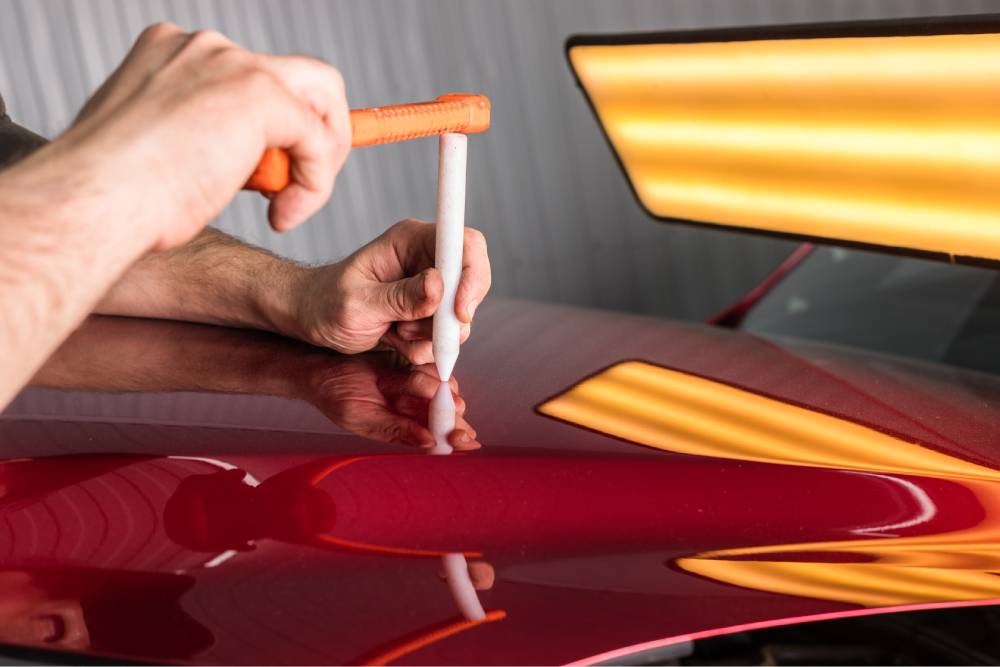
Larger dents take more time to work out. A technician works the metal gradually from multiple points, and a bigger surface area means more passes and more repositioning. Minor door dings — the kind left by a car door in a parking lot — are the smallest and cheapest category. As the dent grows beyond a few inches in diameter, the work time increases and so does the price.
2. Depth and shape
Depth matters more than size in many cases. A shallow but wide dent on a flat panel is often easier to address than a small but sharp dent with a crease. Sharp creases and deep point impacts stretch the metal — and stretched metal doesn’t always return to a perfectly smooth surface through massage alone. When a dent is too deep or too sharply defined for PDR to produce a clean result, conventional body repair with filler is the more appropriate choice, regardless of how small the dent looks.
3. Location on the panel
Where the dent sits on the panel affects both difficulty and risk. A dent in the center of a flat surface gives the technician room to work with good visibility and a predictable metal response. A dent near a body line — the styled creases that run along most modern vehicles — is harder to address because the metal behavior near a line is less predictable and the margin for error is smaller. Dents near panel edges, door handles, or trim mounting points present similar challenges.
4. Access to the back of the panel
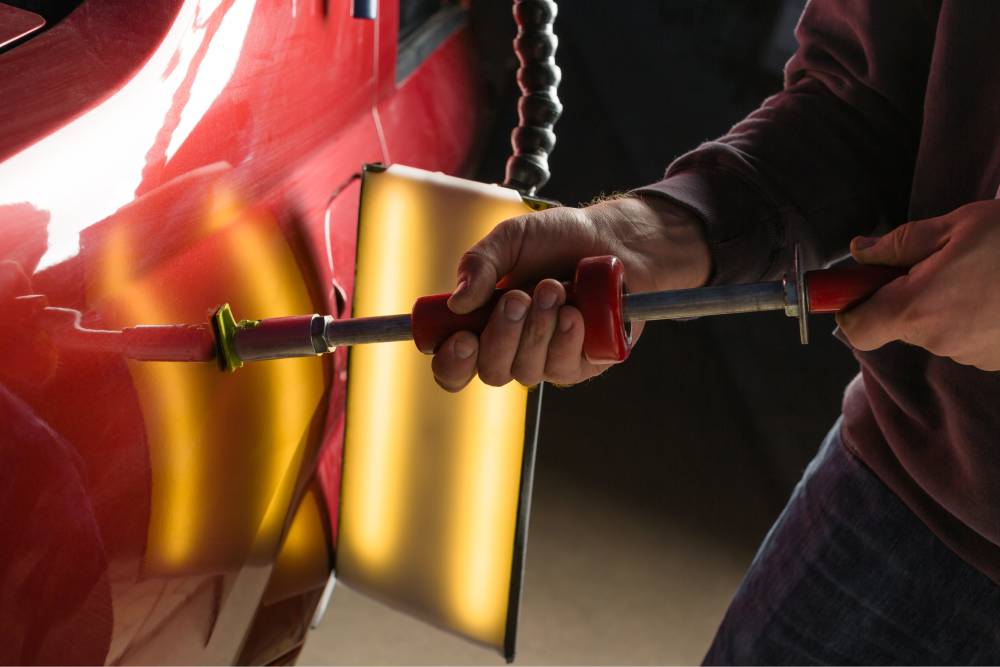
PDR works from behind the panel. If a technician can reach the back of the dent easily — through a door opening, a removed interior trim piece, or a standard access point — the job is straightforward. When the dent is behind factory bracing, in a location that requires removing exterior components to access, or on a panel where the geometry limits tool positioning, the job takes significantly longer. Some dents require removing a door panel, a light assembly, or other components just to get a tool into position — that labor adds to the total.
5. Panel material
Aluminum has replaced steel on hoods, doors, and fenders on many vehicles over the last decade. Aluminum behaves differently than steel under PDR tools — it’s less forgiving, more prone to tearing if pushed too aggressively, and requires a technician with specific experience working with the material. Aluminum panel repairs typically cost more than the same repair on steel, and not every PDR technician is equally skilled with both.
Typical price ranges in the U.S.
These are market ranges for professional PDR at an established shop. In North Miami Beach and South Florida, pricing generally falls toward the higher end of these ranges — labor rates and the vehicle mix here run above national averages.
Minor dents and door dings — $50 to $150 per dent. This covers small, shallow impacts on accessible panels with intact paint.
Medium dents — $150 to $350 per dent. Larger impacts, dents near body lines, or repairs requiring more access work fall here.
Large dents — $400 to $1,000 or more per panel. Complex single impacts, dents in difficult locations, or aluminum panel work.
Multiple minor dents — $300 to $600 for a cluster of small dents on one or two panels, such as from a minor hail event.
Hail damage, full vehicle — $1,000 to $3,000 depending on the number of panels affected and density of impacts. Severe hail events with dozens of dents across the roof, hood, and trunk lid land at the higher end of this range.
These ranges assume paint is intact. When paint is cracked or chipped at the dent site, PDR addresses the metal but a refinishing step is still needed — which adds cost and shifts the repair toward conventional bodywork territory.
Quick cost check
Your PDR price will be lower when the dent is shallow, centered on a flat steel panel, with easy access behind it and intact paint — this is the scenario every technician quotes at the bottom of the range.
It will be higher when any of these change: the dent is deep or has a crease, it sits on a body line or panel edge, the panel is aluminum, access requires removing components, or you’re dealing with multiple dents from hail. Each factor adds time; combinations add up fast.
Hail damage: a different pricing model
Single dents are priced per dent or per panel. Hail damage — where dozens of small impacts are spread across multiple horizontal surfaces — is typically assessed differently. Most shops price hail repair based on the total number of dents and the panels affected, rather than individual dent counts.
In South Florida, hail events are less frequent than in Texas or Colorado but do occur, particularly during summer storm season. When they do, the damage pattern is consistent: small, round dents concentrated on the hood, roof, and trunk lid. This is exactly the damage profile PDR handles best — shallow impacts, spread across accessible panels, usually with intact paint.
For hail damage, most comprehensive auto insurance policies cover the repair with the deductible applied. The math is worth checking before filing: if the repair estimate is $800 and your deductible is $500, paying out of pocket may cost less than the rate impact from a claim.
What PDR costs compared to conventional repair
For the same dent, PDR is typically significantly cheaper than conventional body repair — which involves filling, priming, painting, and blending. A door ding that costs $100 to $150 with PDR could run $400 to $700 through conventional repair, once paint and labor are factored in.
The cost advantage narrows or disappears when PDR isn’t appropriate for the damage. A dent that’s too deep, too sharp, or has cracked paint isn’t a good PDR candidate — pushing it through PDR anyway produces a substandard result that may need conventional repair on top of it.
Speed is also part of the value equation. PDR doesn’t require paint curing time, so most jobs are completed same-day or next-day. Conventional repair on the same panel typically takes three to five days.
Why getting an estimate in person matters
Phone quotes and photo-based estimates are starting points, not final prices. The factors that most affect PDR cost — access, depth, proximity to body lines — aren’t visible in a photograph and can only be assessed by a technician looking at the actual panel.
A shop that quotes a firm price without seeing the car is either very experienced with a narrow range of typical damage or is quoting low to get you in the door. Either way, the price may change when the work starts.
An in-person estimate takes a few minutes and gives you an accurate number before any commitment. It also lets the technician tell you honestly whether PDR is the right approach for the damage or whether conventional repair would produce a better result.
Common questions
On a good PDR candidate — shallow dent, intact paint, accessible panel — the result is typically undetectable in normal light. Results are harder to guarantee on deep dents, aluminum panels, or dents near body lines, where the margin for a perfect outcome is smaller.
Hail damage repaired with PDR is typically covered under comprehensive insurance. Collision damage depends on your policy. In both cases, the deductible applies, and it’s worth comparing the repair cost against the deductible before filing.
Yes. Labor rates in South Florida tend to run higher than national averages, which means PDR pricing in the Miami area falls toward the upper end of the ranges above.
Usually yes — significantly so when the damage is a good PDR candidate. A door ding that costs $100–$150 with PDR can run $400–$700 through conventional repair involving filler, paint, and blending. The gap closes when PDR isn’t the right method for the damage, since a poor PDR result may still need conventional repair on top.
No. PDR works when the paint is intact, the metal hasn’t been overstretched, and the panel is accessible. Sharp creases, deep point impacts, and dents with cracked paint are typically better addressed through conventional body repair.
Want an accurate estimate for your dent?
At AutoBodyLab, PDR assessments are done in person — we look at the actual damage before quoting anything. If PDR is the right approach, we’ll tell you what it costs and why. If conventional repair would produce a better result, we’ll explain that too.